
 772-228-6882



What if the solution to your chronic joint pain isn’t found in a surgeon’s scalpel, but within the hidden healing potential of your own cells? If you’ve spent years managing persistent stiffness with over-the-counter medications, you already know that temporary relief often comes with unwanted side effects and a lingering fear of the operating table. It’s frustrating to feel your world shrinking as you trade morning walks for ice packs and weekend golf outings for rest. You deserve a path forward that respects your body’s biology while addressing the root cause of your discomfort.
We understand that you’re looking for more than just a way to mask the symptoms; you want to return to the activities that make life vibrant. This guide explores how regenerative therapy for arthritis can help you reclaim your mobility by using biological tools like PRP, stem cells, and exosomes to reset your joint environment. We’ll examine how these advanced, non-surgical treatments work to biologically reboot your joints from a state of decay to a state of repair, offering a sophisticated way to restore your quality of life and help you avoid the long recovery times of invasive surgery.
Key Takeaways
- Learn why regenerative therapy for arthritis shifts the focus from temporarily masking pain to modifying the underlying biological environment for lasting relief.
- Discover how customized treatments like PRP and stem cells leverage your body’s innate healing potential to repair and restore damaged joint tissue.
- Understand why managing systemic inflammation and overall wellness is essential to ensuring your body can successfully support new cellular growth.
- Uncover the truth about “bone-on-bone” diagnoses and why you may still be an excellent candidate for non-surgical restoration despite severe imaging results.
- Explore how precision diagnostics and guided injections ensure that your treatment is delivered exactly where it’s needed for maximum functional improvement.
What is Regenerative Therapy for Arthritis?
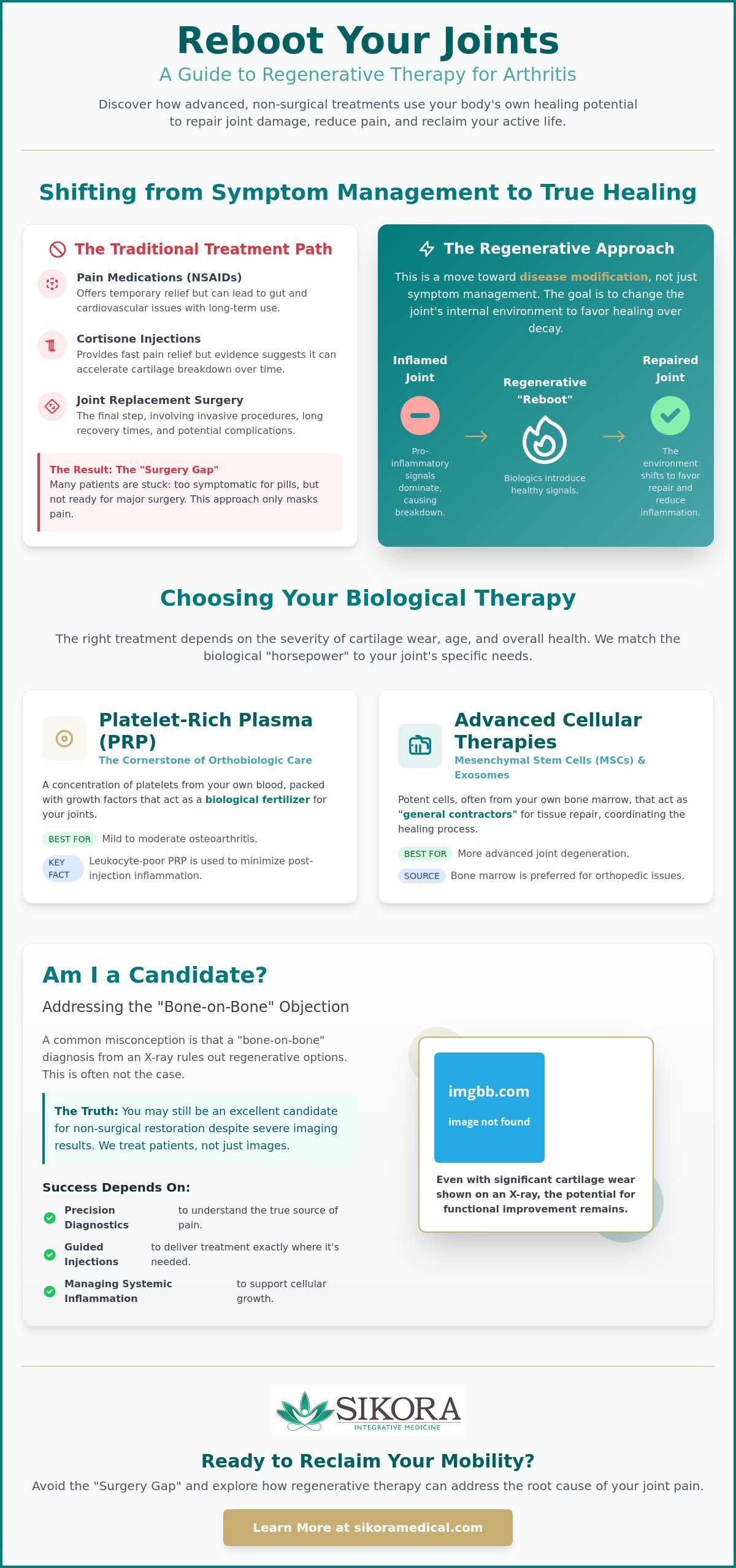
If you’ve spent years managing joint pain, you’ve likely encountered a cycle of temporary fixes that never quite address the core issue. This is where the paradigm shifts. At its heart, regenerative medicine is a specialized subfield of orthobiologics that focuses on replacing or repairing human cells and tissues to restore normal function. Unlike traditional approaches that prioritize symptom management, regenerative therapy for arthritis represents a move toward disease modification. Instead of simply quietening the pain for a few weeks, these treatments aim to modulate the joint’s internal environment to favor healing over decay.
This process relies on the power of signaling molecules. Think of your joints as a complex communication network where cells are constantly talking to each other. In an arthritic joint, that conversation is dominated by “pro-inflammatory” signals that tell the body to break down tissue. Regenerative therapies introduce new, healthy signals that change the narrative. By shifting the cellular dialogue, we can encourage the body to stabilize the joint environment and reduce the chronic inflammation that causes daily suffering.
The Problem with Traditional Arthritis Treatments
For decades, the standard of care has followed a predictable path: pills, then shots, then surgery. While cortisone injections offer fast relief, they come with a hidden cost. Clinical evidence suggests that repeated steroid use can actually accelerate cartilage breakdown over time, potentially worsening the very condition they were meant to treat. Similarly, long-term use of NSAIDs can lead to significant issues with gut health and cardiovascular function. This creates a “Surgery Gap” for many patients. You might find yourself in a difficult middle ground where you’re too symptomatic for simple painkillers, yet you aren’t ready or willing to undergo a major joint replacement and the grueling recovery that follows.
How Biologics “Reboot” the Joint
When a joint becomes arthritic, it enters a self-perpetuating inflammatory cascade. The lining of the joint becomes inflamed, the fluid loses its lubricating properties, and the cartilage begins to fray. Regenerative cells act like biological “general contractors” for tissue repair. They don’t just “grow a new joint” overnight; instead, they coordinate the repair process by recruiting local resources, dampening inflammation, and protecting existing tissue from further wear. Orthobiologics are biological substances used to help injuries heal more quickly. By utilizing these concentrated substances, we can effectively reboot the joint’s natural recovery mechanisms and help you return to the life you love.
PRP, Stem Cells, and Exosomes: Choosing Your Therapy
If you’re exploring regenerative therapy for arthritis, you’ll quickly find that regenerative medicine is an umbrella term for several distinct biological tools. Each therapy offers a different level of potency and signaling capability. Choosing the right one depends on the severity of your cartilage wear, your age, and your systemic health. While some patients find relief with foundational treatments, others require a more sophisticated combination of cellular instructions to see a functional change. The goal is always to match the biological horsepower of the treatment to the specific needs of your joint.
Platelet-Rich Plasma (PRP) Therapy
PRP serves as the cornerstone of orthobiologic care. The process involves drawing a small sample of your blood and concentrating the platelets using a centrifuge. These platelets are packed with growth factors that act as a biological fertilizer for your joints. For mild to moderate osteoarthritis, PRP is often the first line of defense. It’s particularly effective for patients who still have a significant amount of viable tissue to work with. However, the quality of the PRP matters significantly. We distinguish between leukocyte-poor and leukocyte-rich formulas. For most joint injections, we prefer leukocyte-poor PRP because removing the white blood cells helps minimize post-injection inflammation. This creates a calmer, more receptive environment within the joint capsule.
Advanced Cellular Therapies: Stem Cells and Exosomes
When joint degeneration is more advanced, we may look toward Mesenchymal Stem Cells (MSCs). These cells are typically harvested from your own bone marrow or adipose (fat) tissue. Clinicians often prefer bone marrow for orthopedic issues because it contains a high concentration of cells already primed for musculoskeletal repair. These cells function as the general contractors we mentioned earlier, coordinating the repair of the joint environment by signaling to other cells. Exosomes represent the next evolution in this field. They are tiny, cell-free vesicles that carry the precise messages or instructions needed for tissue repair without the need for whole cells. Because they are so small, they can easily navigate the joint environment to deliver their cargo of proteins and genetic information.
Often, the most profound results occur when we combine these therapies. By using PRP to prepare the joint soil and adding stem cells or exosomes as the seeds and instructions, we create a powerful synergistic effect that addresses decay from multiple angles. This multi-layered approach is why regenerative therapy for arthritis has become such a compelling alternative to more aggressive surgical interventions. If you’re ready to see which biological approach fits your needs, consulting with a specialist can help clarify your options.
The Integrative Advantage: Why Systemic Health Matters
Many patients view joint pain as a mechanical failure of a single part, much like a worn-out tire on a car. However, your joints are living biological systems that rely on the health of your entire body to function and repair themselves. Dr. Sikora’s core philosophy is simple: a healthy body grows healthy tissue. If you choose regenerative therapy for arthritis without addressing your underlying systemic health, you’re essentially planting high-quality seeds in poor soil. To achieve the best possible results, we must ensure your internal environment is primed for success.
One of the most critical factors in the success of these treatments is your level of systemic inflammation. We often look at C-Reactive Protein (CRP) levels to gauge how much “fire” is burning throughout your body. If your CRP levels are high, the pro-inflammatory signals can drown out the healing messages delivered by PRP or stem cells. By cooling this systemic inflammation through targeted health coaching and nutritional changes, we create a sanctuary within the joint where regenerative cells can actually do their work. This comprehensive approach is what separates a visionary clinical practice from a standard injection clinic.
Hormones and Joint Repair
If your hormones are out of balance, your body’s ability to synthesize new collagen and maintain tissue integrity is significantly compromised. Testosterone and estrogen aren’t just for reproductive health; they are powerful anabolic signals that tell your musculoskeletal system to stay strong. Optimized levels support the very foundation of your joints. Conversely, low thyroid function can lead to sluggish cartilage repair and increased joint puffiness. This is why Dr. Sikora often recommends a detailed hormone panel before your procedure. By optimizing these levels through Hormone Therapy, we provide your joints with the chemical instructions they need to rebuild and thrive.
Nutritional Support and IV Therapy
Preparing your body for a procedure often starts in our IV Vitamin Drip Lounge. High-dose antioxidants and micronutrients can prime your cellular machinery, ensuring your own cells are as robust as possible before they’re harvested or concentrated. We also emphasize the importance of an anti-inflammatory diet to protect your investment in your health. In some cases, we discuss the role of specific peptides that can help enhance the healing signals of stem cells. When you combine these systemic supports with advanced biologics, you aren’t just treating a symptom. You’re engaging in a holistic restoration process that supports long-term vitality. Being a local provider in Vero Beach allows us to walk this journey with you, providing the consistent follow-up care that is essential for a successful outcome.
Am I a Candidate? Addressing the “Bone-on-Bone” Objection
If a doctor has told you that your joints are “bone-on-bone,” it’s easy to feel like surgery is your only remaining option. This common phrase often describes what is seen on a standard X-ray, where the space between bones appears non-existent. However, an X-ray is a two-dimensional shadow that doesn’t capture the entire biological picture. A more detailed MRI often reveals that some cartilage remains, along with significant inflammation in the synovium, or joint lining. In many cases, the persistent pain you feel isn’t just from the loss of padding, but from this chronic inflammatory state. This distinction is vital because regenerative therapy for arthritis focuses on calming that inflammation and improving the health of the remaining tissue.
Determining your potential for recovery requires the expertise of a Board Certified Physical Medicine & Rehabilitation specialist. These experts look beyond the image to understand how your joint functions in motion. While severe, Grade IV “bone-on-bone” osteoarthritis is generally not considered an ideal match for stem cell therapy because these treatments cannot regrow lost bone, many patients with advanced wear still experience significant functional improvements. If we can modulate the environment within the joint, we can often reduce the pain signals coming from the inflamed lining, even if the cartilage is thin.
Who Benefits Most from Regenerative Therapy?
The patients who typically see the most transformative results are those with Grade 1 through Grade 3 Osteoarthritis. These individuals still have some measurable joint space and are looking to maintain an active lifestyle without the risks of general anesthesia or a long surgical recovery. If you can still perform daily tasks but find yourself limited by late-day aching or morning stiffness, your joint environment is likely receptive to biological signaling. True candidacy is defined by your personal functional goals and the current biological state of your joint rather than just a static image on a screen. We focus on whether we can help you return to the walking trail or the golf course with less reliance on daily medication.
When Surgery Might Still Be Necessary
There are times when the structural damage is too extensive for biologics alone to resolve. If you experience mechanical “locking,” where the joint physically catches or freezes, or if there is severe structural instability, a surgical consultation is often the safest path. However, choosing regenerative therapy for arthritis doesn’t always mean you are abandoning the idea of surgery forever. Many patients use these treatments as a form of “pre-hab” to improve the health of the surrounding tissue, which can potentially lead to a smoother recovery if a replacement eventually becomes necessary. A realistic, honest consultation is the only way to ensure you aren’t chasing a result that biology cannot provide. If you’re ready to find out if you’re a candidate, schedule a comprehensive evaluation to discuss your specific needs.
Your Journey at Sikora Integrative Medicine
Choosing a partner for your recovery is a decision that extends far beyond a single appointment. At Sikora Integrative Medicine, we view regenerative therapy for arthritis as a collaborative journey toward renewed vitality. Your experience begins with a comprehensive evaluation where Dr. Sikora takes the time to understand your pain, your physical limitations, and your long-term functional goals. We don’t just treat an image on a screen; we treat the individual. This initial consultation is an investigative process where we review your medical history and lifestyle factors to ensure that your body is truly ready to respond to biological signaling.
Once we’ve determined the best path forward, the focus shifts to the procedure itself. We believe that professional expertise should be paired with the most advanced delivery methods available. Recovery from these treatments is typically much faster than surgical alternatives, though it requires a bit of patience as your body begins its internal reboot. You’ll likely experience some localized soreness for a few days, which is a natural part of the inflammatory response we are trying to trigger. Over the following weeks and months, the signaling molecules begin their work, and most patients start to notice a gradual improvement in their comfort and range of motion.
The Precision Injection Process
The success of any biological treatment depends entirely on accuracy. If the cells don’t reach the specific site of damage, they can’t do their job. This is why “blind” injections, which rely on feel alone, are a thing of the past in our practice. We utilize ultrasound-guided or fluoroscopic technology to visualize the joint in real-time. This ensures that your PRP, stem cells, or exosomes are delivered with millimeter precision directly into the area of need. This level of accuracy not only improves your potential results but also enhances the safety and comfort of the procedure. Our Vero Beach office is designed to be a sanctuary where these sophisticated, in-office treatments are performed with the highest level of clinical care.
Next Steps: Booking Your Consultation
If you’re ready to explore a life with less pain, the first step is a formal assessment. We encourage you to gather your recent imaging, such as X-rays or MRIs, and any relevant medical records to bring to your first visit. This allows Dr. Sikora to hit the ground running with a clear understanding of your joint health. If you’re coming from outside the immediate area or have a busy schedule, we offer TeleMed Services for initial discussions to see if you’re a candidate before traveling to our clinic. Once your treatment is complete, we provide ongoing support through Health Coaching to help you maintain your results and optimize your long-term longevity. Your path to restoration is just a conversation away. Schedule your regenerative medicine consultation at our Vero Beach office today.
Reclaim Your Active Lifestyle
Your journey toward joint restoration doesn’t have to involve the long recovery times or risks of invasive surgery. We’ve explored how advanced biological tools like PRP and stem cells shift the focus from temporary symptom masking to a meaningful biological reboot. By addressing systemic factors such as hormone balance and inflammation, you provide these therapies with the optimal environment to succeed. Choosing regenerative therapy for arthritis is a proactive step toward honoring your body’s innate healing potential and returning to the hobbies you love.
Dr. Sikora is Board Certified in Physical Medicine and Rehabilitation, providing high-level, localized care in Vero Beach backed by consistent 5-star patient reviews. Our integrative approach ensures that your treatment is supported by a comprehensive look at your overall health, from hormone optimization to IV therapy. If you’re ready to explore a sophisticated, non-surgical path to recovery, we’re here to guide you every step of the way. Book Your Consultation with Dr. Sikora in Vero Beach and take the first step toward a life defined by movement rather than limitation. You deserve to feel vibrant again.
Frequently Asked Questions
Is regenerative therapy for arthritis covered by insurance?
Most insurance providers don’t cover these treatments because they’re currently classified as investigational or experimental. Patients should expect to pay out-of-pocket for their care. While this is the standard in 2026, we focus on providing long-term value by helping you avoid the hidden costs and grueling recovery times associated with major joint replacement surgery.
How long does it take to see results from PRP or stem cell injections?
You’ll typically begin to notice functional improvements within four to six weeks, though the biological repair process continues for several months. Unlike a cortisone shot that provides immediate but temporary numbing, regenerative therapy for arthritis works by slowly modulating the joint environment. Most patients report peak relief between three and six months after their final injection as the tissue environment stabilizes.
Is the procedure painful, and will I need downtime?
The procedure involves a standard needle stick, which we manage with local numbing agents to ensure your comfort. You won’t need significant downtime; most patients return to light daily activities within 24 to 48 hours. We simply ask that you avoid high-impact exercise or heavy lifting for a short period to allow the concentrated biologics to settle effectively into the treated joint space.
How many treatments are typically required for chronic arthritis?
The number of sessions depends on the degree of joint degeneration and your personal health goals. While some patients experience significant relief after a single treatment, others with more advanced conditions may benefit from a series of two or three injections. We’ll create a customized protocol during your initial evaluation that matches the biological horsepower of the therapy to the specific needs of your joints.
Can I drive myself home after a regenerative joint injection?
You can typically drive yourself home after the procedure since we don’t use general anesthesia or heavy sedation. Most patients feel comfortable enough to operate a vehicle immediately following the in-office treatment. If you’re having multiple joints treated at once or feel particularly anxious about the process, you’re always welcome to bring a companion to drive you for added peace of mind.
What is the difference between stem cells and exosomes for arthritis?
Mesenchymal stem cells are whole cells that act as general contractors to coordinate repair, while exosomes are the specific signaling vesicles those cells use to communicate. Think of stem cells as the managers on a construction site and exosomes as the precise blueprints or instructions for the job. Exosomes provide a cell-free option that can be highly effective for signaling repair without harvesting your own tissue.
Are there any side effects to regenerative medicine?
Side effects are generally mild and limited to the injection site, including temporary swelling, redness, or a dull ache for a few days. Because we use your own biological material in PRP and stem cell therapies, the risk of an allergic reaction or rejection is extremely low. These treatments are a sophisticated departure from more aggressive methods, prioritizing your body’s natural safety profile while encouraging internal healing.
Does Dr. Sikora perform the injections personally?
Yes, Dr. Sikora personally performs all regenerative injections to ensure the highest level of precision and patient care. As a Board Certified specialist, he utilizes advanced ultrasound or fluoroscopic guidance for every procedure he conducts. This hands-on approach ensures that your regenerative therapy for arthritis is delivered exactly where it’s needed, providing you with the steady, guiding hand of an experienced clinician throughout your journey.

 1255 37th St. Suite B,