
 772-228-6882




TB006 for dementia is an investigational treatment being studied for potential effects on memory and cognitive function; it is designed to bind galectin-3, a protein described as helping beta-amyloid proteins clump together. A study is evaluating safety and effects in older adults with mild to severe Alzheimer’s disease for up to three months, so its potential benefits and risks remain under evaluation. Here, you’ll learn what has been reported, how TB006 is proposed to work, what safety uncertainties remain, and which criteria may affect eligibility for a clinical study or expanded access.
Key Takeaways
- Learn how study eligibility is assessed, including age, cognitive test results, and treatment history.
- Understand why TB006 remains investigational and what that means when weighing potential benefits and safety uncertainties.
- See how the proposed interaction with galectin-3 may relate to beta-amyloid buildup and inflammation.
- Review the study’s reported infusion schedule and the distinction between clinical study participation and expanded access.
Why Is TB006 a Potential Investigational Treatment for AD?
TB006 is being studied for potential effects on memory and cognitive function in Alzheimer’s disease. Unlike approved treatments such as lecanemab and donanemab, TB006 remains investigational, so its evidence and access pathway differ.
Comparison With Approved Treatments
The key distinction is treatment status: lecanemab and donanemab are approved Alzheimer’s treatments, while TB006 is still under study. When comparing them, consider the evidence available for each treatment, its safety information, and whether the person’s diagnosis and circumstances fit its use. TB006’s clinical research examines potential effects on Alzheimer’s symptoms, but does not establish it as an equivalent alternative.
Studied Doses and Administration
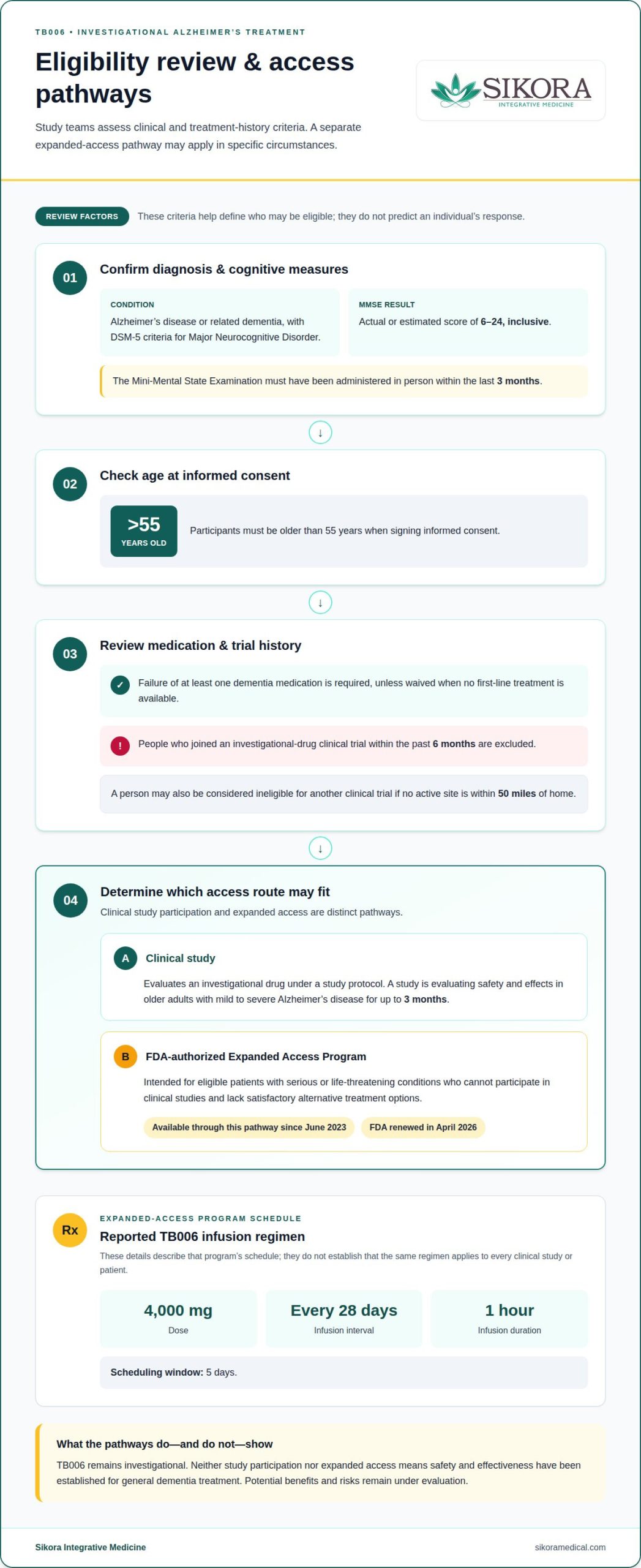
The TB006 expanded-access program uses a dose of 4,000 milligrams intravenously every 28 days, with a 5-day scheduling window. Each infusion is given over 1 hour. These details describe that program’s schedule; they are not evidence that the same regimen applies to every clinical study or patient. The administration route and schedule are relevant when considering participation and treatment logistics.
Alzheimer’s Disease and Related Dementia
Study eligibility focuses on Alzheimer’s disease and related dementia, with a required actual or estimated Mini-Mental State Examination score from 6 to 24, inclusive. The MMSE must have been administered in person within the last 3 months. Eligibility also refers to the Diagnostic and Statistical Manual of Mental Disorders, Fifth Edition criteria for Major Neurocognitive Disorder. These measures help define the study population, rather than predicting an individual’s response.
Participants must be older than 55 years when signing informed consent. The criteria also require failure of at least one dementia medication, unless that requirement is waived when no first-line treatment is available. People who joined an investigational-drug clinical trial within the past 6 months are excluded. A person may also be considered ineligible for another clinical trial if no active site is within 50 miles of home. Study teams assess these criteria to determine whether enrollment is possible.
Investigational status and safety uncertainties
TB006 remains investigational, so its safety and effectiveness for dementia are still being evaluated. The FDA-authorized Expanded Access Program offers a separate pathway for certain eligible patients.
Investigational Status and FDA Oversight
The FDA renewed the TB006 Expanded Access Program for dementia and Alzheimer’s disease in April 2026. TB006 has been available through this pathway since June 2023. Expanded access is intended for eligible patients with serious or life-threatening conditions who cannot participate in clinical studies and lack satisfactory alternative treatment options. It is not the same as routine use of an approved treatment.
For a patient, the distinction matters. A clinical trial evaluates an investigational drug under a study protocol, while expanded access addresses a specific situation for patients unable to join a study. Neither pathway means TB006 has established safety and effectiveness for general dementia treatment. The clinical study evaluates safety and effects in older adults with mild to severe Alzheimer’s disease for up to three months.
Safety Uncertainties and Online Products
No. An online listing alone does not show that a TB006 product is part of the FDA-authorized program or that it is safe to use for dementia. The program’s defined access pathway is different from purchasing a product online. Avoid treating an online claim as proof of clinical oversight, product identity, or suitability for a person with Alzheimer’s disease.
Safety remains under evaluation because TB006 is investigational. The available study period of up to three months cannot establish long-term safety or predict how every person may respond. A patient’s eligibility for expanded access also depends on the program’s criteria, including inability to participate in clinical studies and lack of satisfactory alternative treatment options. Those requirements distinguish the program from general online availability.
TB006’s proposed mechanism targeting galectin-3
TB006 is designed to bind galectin-3, a protein described as helping beta-amyloid proteins clump together. That proposed interaction is the starting point for its investigational approach to Alzheimer’s disease. It focuses on a biological process associated with amyloid buildup, rather than establishing that the treatment improves memory or other cognitive abilities.
The proposed sequence is straightforward: TB006 binds galectin-3, which may affect the protein’s role in beta-amyloid clumping. Researchers are evaluating whether this approach could relate to changes in Alzheimer’s symptoms, amyloid plaque buildup, or neuroinflammation. These are potential effects being studied, not established outcomes for patients.
This distinction matters when interpreting claims about galectin-3. A proposed molecular target can explain why researchers are studying a drug, but it cannot by itself show that a person will experience cognitive benefit. Clinical evaluation must examine how the investigational treatment affects people with Alzheimer’s disease. TB006’s proposed mechanism and its clinical effects are related questions, but they are not interchangeable.
The expanded access pathway also does not establish that galectin-3 binding reduces symptoms. It provides access for eligible patients in defined circumstances, while the treatment remains investigational. For you, the useful takeaway is to separate the biological rationale from evidence of safety and effectiveness. Galectin-3 and beta-amyloid help explain what TB006 is intended to target; study results determine whether that approach translates into meaningful effects. Until those effects are established, the proposed mechanism should be understood as a research hypothesis, not proof of a dementia treatment benefit.
What doses of TB006 have been studied for dementia, and how is it administered?
The TB006 expanded-access program uses 4,000 milligrams intravenously every 28 days, with a 5-day scheduling window. Each infusion is given over 1 hour. This is a specific program regimen, not a general dosing instruction for everyone with dementia.
These details clarify three parts of administration: the amount, the route, and the interval. “Intravenously” means the medicine is delivered into a vein. The 28-day interval describes the planned time between doses, while the 5-day window allows scheduling within that period. The infusion itself takes 1 hour.
For patients and caregivers, the schedule can help frame practical questions about participation. Ask how an infusion appointment fits with existing care, what scheduling within the 5-day window involves, and which program criteria apply. The regimen alone does not determine whether someone can participate. Eligibility for expanded access depends on the program’s conditions, including inability to participate in clinical studies and lack of satisfactory alternative treatment options.
Keep the setting in view when interpreting the dose. The stated 4,000-milligram schedule belongs to the expanded-access program; it should not be treated as a personal dosing recommendation or assumed to describe every TB006 study. An investigational treatment’s protocol defines how it is administered in that program. That distinction helps prevent confusion between a study regimen and a treatment plan for an individual.
If you have questions about medical care and research options, contact the medical team for a conversation.
Sikora Integrative Medicine
In Vero Beach, Sikora Integrative Medicine helps patients understand health claims and consider care options in context. TB006 remains investigational, and discussing other health needs is separate from deciding about research participation. The practice explains evidence and regulatory status before a patient decides, supporting an informed conversation without promising a particular outcome.
Stem Cells, Exosomes, and Hormone Therapy are separate services, not TB006 or established Alzheimer’s treatments. If you are considering care, it can help to clarify your goals and how any option relates to existing medical treatment. The team can discuss those distinctions in plain language so you can better understand the choices relevant to your health.
A conversation can help you organize questions about current care and the concerns you hope to address. You may include a family member or caregiver to discuss priorities and next steps. The aim is to understand the available options, not to assume that another service treats dementia.
Dr. Alita Sikora and her clinical team bring a physician-led perspective to discussions about evidence and care options in Vero Beach. If you have questions about TB006 or broader health goals, contact Sikora Integrative Medicine to speak with the team.
Choose a thoughtful next step
As you consider TB006 for dementia, separate questions about research participation from decisions about ongoing care. Write down the priorities that matter to you, such as maintaining daily routines, clarifying care goals, or exploring broader wellness approaches. For those interested in evidence-based strategies to support cognitive vitality and healthy aging, organizations such as Emagene Life provide insights into precision longevity programs. This can help you and your family have a more focused conversation with a qualified healthcare provider.
This content is for educational purposes only and is not medical advice. Consult a qualified healthcare provider about diagnosis, treatment decisions, or whether a research option may be appropriate. Base care decisions on the person’s individual needs and guidance from their healthcare team.
Sikora Integrative Medicine’s team explains evidence and regulatory status as patients consider care options. Its services address other health needs, not TB006 or established dementia treatment. If you want to discuss broader health goals, contact Sikora Integrative Medicine. An informed conversation can help you consider your next step with greater confidence.
Frequently Asked Questions
What are the clinical results?
The information summarized here does not include clinical outcome figures, so it cannot establish a specific cognitive benefit. When reviewing a results report, look for the outcomes measured, participant numbers, comparison groups, and follow-up period. These details help distinguish measured changes from study goals or proposed treatment effects. A scientific rationale alone does not show that patients benefit.
What is TB006?
TB006 is an investigational treatment being studied for potential effects related to Alzheimer’s disease. Its research-stage status is central to understanding what the name means: it describes a treatment under evaluation, not a routine dementia therapy. If you encounter TB006 mentioned in a study or access context, consider that setting before interpreting claims about its role in a person’s care.
What is TB006 and how is it proposed to work for dementia?
TB006 is designed to bind galectin-3, a protein associated with beta-amyloid clumping. That proposed molecular action gives researchers a reason to evaluate it in Alzheimer’s disease, but it does not by itself show that symptoms change. For families researching TB006 for dementia, the useful distinction is between a biological rationale and clinical evidence measuring effects in people.
Has TB006 been tested in humans, and what were the trial results?
Yes, TB006 is being evaluated in people with Alzheimer’s disease. The information covered here does not give numerical trial outcomes that would support a specific claim about memory, daily activities, or disease progression. When considering a reported result, identify whether it describes participant outcomes or simply what the study was designed to assess. That distinction helps keep expectations grounded in evidence.
Is TB006 FDA-approved or available by prescription for dementia in the United States?
No. TB006 is investigational, so it is not an FDA-approved dementia treatment available through ordinary prescription use. FDA authorization of an expanded-access pathway should not be read as approval of the treatment itself. If you see a product advertised for sale, do not assume the advertisement establishes its relationship to a clinical study or authorized access program.
What is the current clinical trial status of TB006, and how can patients enroll?
TB006 remains under clinical evaluation, and enrollment depends on a study’s active sites and screening process. A patient or caregiver can begin by discussing interest with the person’s treating clinician, then asking the study team about current enrollment and screening. Before deciding, review the study’s purpose, procedures, possible risks, and consent information together. For families considering TB006 for dementia, enrollment is a separate decision from routine care.

Article by
Alita G. Sikora, MD
Dr. Alita Gonsalves Sikora, MD, specializes in Physical Medicine and Rehabiltation (also known as Physiatry) and has practiced in Vero Beach since 2007. She started her own practice, Sikora Integrative Medicine, in 2017 in Vero Beach and also offers telemedicine to Florida residents.
Physical Medicine and Rehabilitation is a medical specialty focused on restoring function and treating pain in the bones, muscles, joints, and nervous system, most often without surgery. She trained at the University of Connecticut School of Medicine and did her residency training at NY Presbyterian (Columbia and Cornell) in NYC.
She offers regenerative and integrative approaches, treating chronic pain and musculoskeletal conditions with stem cells, PRP, exosomes, peptides, shockwave therapy, laser therapy, acupuncture, and prolotherapy, as well as traditional medications and injections. She also certifies qualified patients for medical marijuana in the state of Florida.
She also offers bioidenical hormone optimization including pellets, medical weight loss, peptides, IV vitamin therapy, and functional lab testing.

 1255 37th St. Suite B,