
 772-228-6882



Pain relief can begin with a signal, not an incision. Shockwave therapy uses sound and pressure waves to stimulate the body’s healing response in injured tendons and other soft tissues.
If you’re dealing with persistent pain, you deserve to understand what treatment involves, including possible side effects and complications. This guide explains how the approach works and what to consider when deciding whether it may fit your needs in Vero Beach.
Key Takeaways
- Learn which tendon, soft-tissue, and bone conditions may be considered for this treatment.
- Understand how focused waves differ from radial pressure waves and why the target tissue matters.
- Know which short-term effects may occur and which potential complications call for careful assessment.
- See how mechanical stimulation can trigger cell signaling and support the body’s tissue-repair processes.
Are there any side effects or complications?
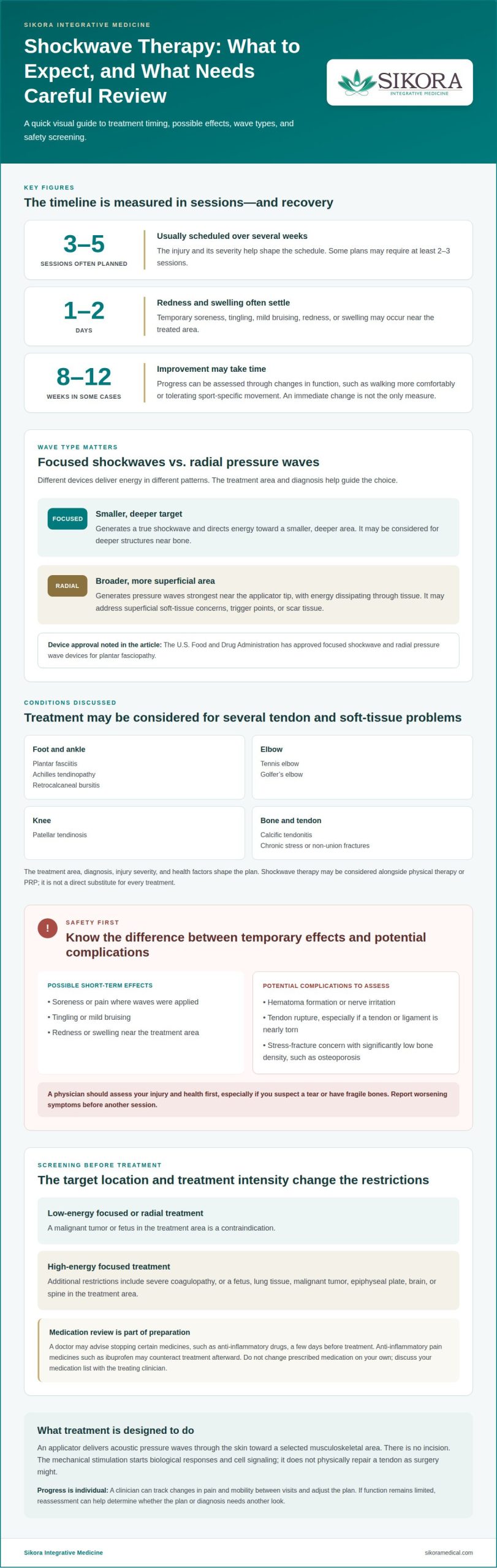
After treatment, you may notice soreness, tingling, mild bruising, redness, or swelling near the treatment area. Redness and swelling usually subside in a day or two. Skin erythema, meaning visible redness, and pain where the waves were applied are also documented effects. These temporary responses differ from more serious complications, which need careful attention.
Conditions commonly treated include plantar fasciitis, Achilles tendinopathy, tennis elbow, golfer’s elbow, calcific tendonitis, and patellar tendinosis. Retrocalcaneal bursitis and chronic stress or non-union fractures are also among the conditions addressed. These musculoskeletal problems affect different structures, from the plantar fascia under the foot to tendons around the elbow and knee—areas where podiatry providers like activefootcare.com.au routinely evaluate foot pain and mobility concerns. The treatment area and diagnosis shape the plan.
For common conditions, this approach offers a non-invasive option that may be considered alongside physical therapy or PRP. It isn’t a direct substitute for every treatment; the choice depends on the tissue involved, injury severity, and health factors. Physical therapy can address movement and strength, while PRP uses a patient’s own blood components. Combining approaches should follow an assessment of the injury and treatment goals.
Treatment plans often involve three to five sessions over several weeks, depending on the injury. Some plans may require at least two to three sessions, with severity influencing the schedule. A clinician can track changes in pain and mobility between visits and adjust the plan. If symptoms worsen, report the change before another session.
More serious risks include hematoma formation, nerve irritation, swelling, or tendon rupture. A tendon or ligament that is nearly torn could tear completely during treatment. Significantly low bone density, such as osteoporosis, may also raise concern about stress fractures. A physician should assess your injury and health first, especially if you suspect a tear or have fragile bones.
What is shockwave therapy?
Shockwave therapy, also called extracorporeal shockwave therapy (ESWT), delivers sound and pressure waves through the skin without an incision. The procedure aims to stimulate the body’s healing response in a selected area. Its history includes lithotripsy, which urologists used to break up kidney stones in the early 1980s. Musculoskeletal treatment uses different devices and goals.
Focused devices generate a true shockwave and direct energy toward a smaller, deeper target. Electrohydraulic, electromagnetic, or piezoelectric systems can generate these waves. Radial devices generate pressure waves instead. Their energy is strongest near the applicator tip, then dissipates as it travels through tissue. In practice, focused treatment can reach deeper structures, while radial treatment covers a broader, more superficial area, such as the length of a tendon. Broad-focused may describe an intermediate coverage pattern, but it isn’t interchangeable with radial pressure waves.
These differences help explain why clinicians select different wave therapies for different treatment areas. Focused shockwave therapy may be considered for deeper structures near bone. Radial treatment may address superficial soft-tissue concerns, trigger points, or scar tissue. The U.S. Food and Drug Administration has approved focused shockwave and radial pressure wave devices for plantar fasciopathy. Device type and diagnosis shape how energy is delivered.
Most insurance plans don’t cover focused or radial pressure wave treatment. In Vero Beach, a qualified clinician can assess your diagnosis, health history, and treatment target. Ask how the device’s wave pattern relates to your condition and what risks apply. An assessment helps determine whether this non-invasive procedure fits your needs.
Potential side effects and complications
Safety screening involves more than checking the painful spot. For low-energy focused and radial wave treatment, a malignant tumor or fetus in the treatment area is a contraindication. High-energy focused treatment has additional restrictions: severe coagulopathy, or a fetus, lung tissue, malignant tumor, epiphyseal plate, brain, or spine in the treatment area. These distinctions make treatment type and target location central to assessing suitability.
Medication review is another practical part of preparation. A doctor may advise you to stop certain medicines, such as anti-inflammatory drugs, a few days before treatment. Afterward, anti-inflammatory pain medicines such as ibuprofen may counteract the treatment. Don’t change prescribed medication on your own. Discuss your medication list with the treating clinician and follow individualized instructions.
For sports injuries, a potential benefit is addressing a persistent tendon problem without an incision. A runner with chronic Achilles symptoms, for example, may discuss whether wave treatment fits alongside activity modification and rehabilitation. The decision depends on the diagnosis, tissue involved, and the athlete’s goals. It isn’t a universal shortcut back to sport, and return-to-play planning should reflect the injury, not the athlete’s schedule.
Benefits are assessed through meaningful changes in function, such as walking more comfortably or tolerating sport-specific movement. Improvement after focused or radial treatment can take 8 to 12 weeks in some cases, so an immediate change isn’t the only measure of progress. If function remains limited, reassessment can help determine whether the plan or diagnosis needs another look.
Before proceeding, make sure the clinician knows about relevant diagnoses, medications, and the precise location of your symptoms. This information helps identify contraindications and match treatment intensity to the clinical situation. For athletes, clear communication about training demands also helps keep decisions grounded in tissue health and safe recovery.
How extracorporeal shockwave therapy works
“Extracorporeal” means the energy is delivered from outside your body. During treatment, an applicator sends acoustic pressure waves through the skin toward a selected musculoskeletal area. No incision is made, and the procedure doesn’t involve surgery. The waves create mechanical stimulation within tissue, starting a chain of biological responses rather than physically repairing a tendon as surgery might.
Each pulse produces a positive pressure wave followed by a negative pressure wave. This mechanical input triggers biochemical reactions, releases biomolecules, and activates cell signaling. Those signals influence how cells respond in the treatment area. For an Achilles tendon problem, the clinician directs energy toward the affected tissue, where local cells receive this stimulation. The response is biological, not simply a temporary change in how the area feels.
Three effects help explain the approach: angiogenesis, inflammatory modulation, and stimulation of tissue regeneration. Angiogenesis is the formation of new blood vessels, which supports the local healing environment. Inflammatory modulation means influencing the tissue’s inflammatory response. Cell signaling also prompts activity connected with tissue repair. Together, these processes explain why treatment aims to stimulate the body’s response in a targeted area.
Focused shockwave directs energy into a smaller, deeper target, including tissue near bone. Radial pressure waves spread across a broader, more superficial area. The injury’s location and the structure involved guide which pattern is used. For musculoskeletal conditions such as chronic Achilles tendon pain, selecting the treatment area matters because the energy must reach the intended tissue. This non-invasive approach supports healing differently from surgery, but it does not replace diagnosis or determine the cause of pain on its own.
If persistent tendon or joint pain is limiting movement, discuss musculoskeletal pain care and the treatment approach suited to your needs.
Sikora Integrative Medicine: Hormone Therapy
Sikora Integrative Medicine offers regenerative medicine options for people with ongoing musculoskeletal concerns who want to discuss care beyond symptom management. After an evaluation, you can learn whether PRP, Stem Cells, or Exosomes may be appropriate to consider alongside or after other approaches. PRP is prepared from your own blood. The clinician can explain the evidence and regulatory status of available options before you decide.
Hormone Therapy is a separate service, not a treatment for tendon or joint injuries. If you’re exploring it for hormone-related concerns, a personalized discussion can help clarify whether it fits your health needs.
Contact Sikora Integrative Medicine to discuss your concerns and possible next steps.
Choose a next step that fits your goals
Moving forward starts with connecting your symptoms to a clear treatment goal. If pain affects walking, work, or exercise, discuss how shockwave therapy may fit your care and what an assessment should consider. Your health history, the affected tissue, and the possibility of a significant tendon injury all matter when weighing options.
Sikora Integrative Medicine also offers PRP, Stem Cells, and Hormone Therapy for distinct patient needs. These services aren’t interchangeable: the right discussion depends on whether you’re seeking support for a musculoskeletal concern or addressing a separate health issue. The medical team can explain relevant evidence and considerations to help you make an informed decision.
Bring your questions about treatment goals, risks, and how progress will be reviewed. A thoughtful conversation can help you understand your options and decide what feels appropriate for your health. Contact Sikora Integrative Medicine to discuss a next step that aligns with your needs.
Frequently Asked Questions
What is shockwave therapy and how does it work?
Shockwave therapy delivers acoustic energy from an applicator outside the body to a selected area. The mechanical stimulus prompts biochemical reactions and cell signaling, which can influence blood-vessel formation, inflammation, and tissue repair. For example, a clinician may direct energy toward a painful tendon rather than treating the entire limb. It’s a non-invasive approach, but assessment helps determine whether the targeted tissue is suitable for treatment.
What conditions is shockwave therapy used to treat?
It’s used for selected musculoskeletal problems, including plantar fasciitis, Achilles tendon disorders, tennis elbow, and calcific tendonitis. The diagnosis matters: heel pain may arise from plantar fascia irritation, while pain behind the heel may involve the Achilles tendon or nearby structures. Treatment planning considers the affected tissue, symptoms, and health history. It isn’t a universal option for every source of foot, elbow, or knee pain.
What does research say about shockwave therapy’s effectiveness?
Research examines outcomes such as pain and function for specific conditions, rather than establishing one result for every injury. Some studies have found shockwave treatment for spasticity was not inferior to botulinum toxin treatment. That finding concerns spasticity, not tendon pain, so it shouldn’t be applied broadly. For a musculoskeletal concern, ask whether evidence addresses your diagnosis and the outcome you want to improve.
What is the difference between focused and radial shockwave therapy?
Focused devices concentrate a true shockwave on a smaller, deeper target; radial devices deliver pressure waves that spread across a broader, more superficial area. For example, a deeper target near bone may call for a different wave pattern than a broad region of soft tissue. The terms describe different energy delivery, not simply stronger and weaker versions of one treatment. The target tissue helps guide the choice.
What happens during a shockwave therapy session, and how many sessions are typical?
A clinician places an applicator over the selected area and delivers pulses, adjusting energy in response to your feedback. Treatment sessions are typically brief. Treatment plans commonly involve three to five visits over several weeks, with the injury influencing the schedule. You may feel pressure or discomfort during application. Tell the clinician if the sensation becomes difficult to tolerate so treatment can be reassessed.
What are the side effects and risks of shockwave therapy?
Temporary effects can include soreness, redness, bruising, tingling, or swelling where the applicator contacts the skin. More serious concerns include nerve irritation, a hematoma, or tendon rupture, especially if a tendon or ligament is nearly torn. Significantly low bone density, such as osteoporosis, also matters because of stress-fracture risk. This information is for educational purposes only, not medical advice. Consult a qualified healthcare provider about your health and treatment risks.

Article by
Alita G. Sikora, MD
Dr. Alita Gonsalves Sikora, MD, specializes in Physical Medicine and Rehabiltation (also known as Physiatry) and has practiced in Vero Beach since 2007. She started her own practice, Sikora Integrative Medicine, in 2017 in Vero Beach and also offers telemedicine to Florida residents.
Physical Medicine and Rehabilitation is a medical specialty focused on restoring function and treating pain in the bones, muscles, joints, and nervous system, most often without surgery. She trained at the University of Connecticut School of Medicine and did her residency training at NY Presbyterian (Columbia and Cornell) in NYC.
She offers regenerative and integrative approaches, treating chronic pain and musculoskeletal conditions with stem cells, PRP, exosomes, peptides, shockwave therapy, laser therapy, acupuncture, and prolotherapy, as well as traditional medications and injections. She also certifies qualified patients for medical marijuana in the state of Florida.
She also offers bioidenical hormone optimization including pellets, medical weight loss, peptides, IV vitamin therapy, and functional lab testing.

 1255 37th St. Suite B,