
 772-228-6882




Cell Science micronutrient testing at Sikora Integrative Medicine uses a whole blood sample to assess how micronutrients affect immune-cell function, and its Cellular Micronutrient Assay panel lists 55 items. That cellular focus offers a different view from a snapshot of nutrient levels in serum, giving you information to discuss as part of a broader picture of your health.
If you’re looking beyond a single nutrient result, understanding what the assay measures can help you decide whether this testing fits your goals. This guide explains its purpose, biomarkers, sample processing, and laboratory standards so you can approach results with clear expectations.
Key Takeaways
- The Cellular Micronutrient Assay uses a whole blood sample to assess how nutrients affect immune-cell function.
- Its panel lists 55 items, while related assays examine antioxidant function and protection against oxidative stress.
- Understand how CLIA oversight and high-complexity laboratory standards relate to the testing process.
- Learn what cellular results can add to your health discussion and how to interpret them in context.
Laboratory credentials and quality standards
Laboratory quality has two parts: the assay method and laboratory oversight. The Cellular Micronutrient Assay uses a lymphocyte proliferation assay, in which laboratory staff assess how immune cells respond when exposed to nutrients. This differs from measuring nutrient concentrations directly in serum. The method describes a cellular response; by itself, it does not establish how results can guide care.
Intracellular micronutrient testing offered by SpectraCell Laboratories and IntraCellular Diagnostics is available under CLIA. Laboratories offering laboratory-developed tests must hold CLIA licensure for high-complexity testing. The U.S. Food and Drug Administration has chosen not to require regulatory review of intracellular micronutrient testing. CLIA oversight concerns laboratory standards, not clinical benefit. These distinctions clarify what laboratory credentials address and what they do not.
The listed turnaround time for the Cellular Micronutrient Assay is 10 days. A clinician can review findings alongside symptoms, medical history, and other relevant test results. This context matters because one laboratory result does not diagnose every possible cause of a health concern.
Sikora Integrative Medicine is located in Vero Beach, Florida. CLIA status describes laboratory oversight; it does not determine whether a person who is not a patient may receive testing.
Quality review should distinguish the analytical process, laboratory oversight, and clinical interpretation. A CLIA credential addresses the laboratory’s regulatory framework; it does not establish that intracellular results are more useful than standard testing for everyone. According to Springer Nature, pregnancy-related changes can make micronutrient status difficult to assess accurately using conventional cutoffs. A clinician can account for individual context when interpreting findings.
Purpose of the Cellular Micronutrient Assay
The Cellular Micronutrient Assay (CMA) assesses how micronutrients affect immune-cell function. It differs from a serum test, which captures nutrient levels in blood at collection. These methods address different questions: one examines a cellular response, while the other provides a blood-level snapshot. A clinician can consider either result alongside your health history and other findings.
The Redox Assay measures the overall antioxidant function of immune cells. The Antioxidant Protection Assay examines specific antioxidants that may improve antioxidant capacity and protect cells from oxidative damage. These assays focus on antioxidant activity, not the CMA’s assessment of nutrient effects on immune function. Knowing which assay was performed helps you understand what its report describes.
Insurance coverage depends on the policy and plan. Blue Cross & Blue Shield of Rhode Island considers intracellular micronutrient panel testing not medically necessary for commercial plans and does not cover it for Medicare Advantage Plans, citing insufficient evidence about health outcomes. That policy applies to Rhode Island, not Florida. No specific CPT code exists for the panel; claims should use an unlisted code.
To schedule testing, arrange the collection through a clinic. Preparation for the Cellular Micronutrient Assay starts up to 4 hours before collection. Follow the clinic’s instructions for your appointment, and share relevant health information so results can be reviewed in context.
One limitation is uncertainty about how cellular results compare with standard vitamin or mineral testing. A policy review found no studies evaluating the assay’s analytic validity, clinical validity, or clinical utility against standard testing. This evidence gap means a result should be treated as one piece of health information, not a diagnosis on its own.
The assay focuses on how micronutrients affect a patient’s immune function, with the aim of identifying nutrient insufficiencies. It assesses immune-cell responses to nutrients rather than directly measuring nutrient levels in blood. This describes what the test is designed to assess; results should still be considered alongside other health information.
By testing nutrients in immune cells, the assay is intended to reflect long-term nutrient status rather than only the snapshot provided by a serum test. The two approaches provide different information: one reflects nutrient status over time, while the other reports blood levels at collection. Neither description alone makes the assay a diagnosis.
Micronutrients and other biomarkers measured
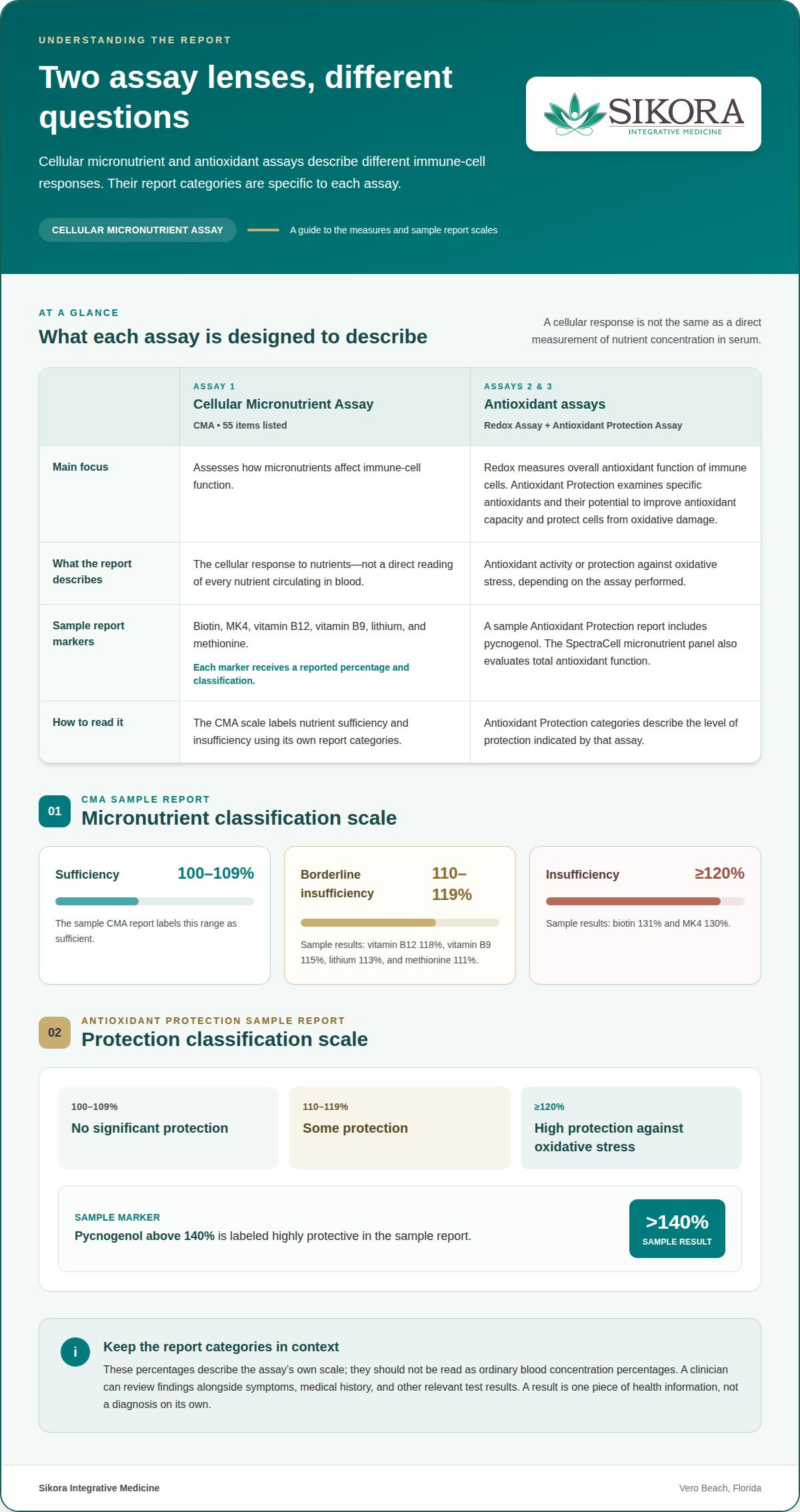
The Cellular Micronutrient Assay (CMA) panel lists 55 items. Sample CMA reports include biotin, MK4, vitamin B12, vitamin B9, lithium, and methionine. These examples span several nutrient types, rather than focusing on a single vitamin. Each marker receives its own reported percentage and classification. The results describe the assay’s cellular response, not a direct measurement of every nutrient circulating in your blood. Reviewing the named markers helps you understand what the report covers and what each result represents.
Sample CMA reports classify nutrient sufficiency from 100% to 109%. Results from 110% to 119% are labeled borderline insufficiency, while results of at least 120% are labeled insufficiency. For example, biotin at 131% and MK4 at 130% are labeled insufficient. Vitamin B12 at 118%, vitamin B9 at 115%, lithium at 113%, and methionine at 111% are labeled borderline. These report categories describe the assay’s own scale; they should not be read as ordinary blood concentration percentages.
Antioxidant testing adds a different view. The sample Antioxidant Protection Assay classifies results of at least 120% as high protection against oxidative stress. Results from 110% to 119% indicate some protection, while 100% to 109% indicates no significant protection. One sample report labels pycnogenol above 140% as highly protective. The SpectraCell micronutrient panel also evaluates total antioxidant function, which summarizes antioxidant activity rather than identifying only one nutrient.
Use the report’s marker names and categories as discussion points, not as a stand-alone diagnosis. A clinician can compare examples such as borderline B12 and insufficient biotin with your symptoms, health history, and other findings. That context helps distinguish a laboratory classification from a decision about nutrition or care. The 55-item panel can organize questions, but each result needs individual interpretation.
How does Cell Science micronutrient testing work, and what sample is collected?
The Cellular Micronutrient Assay uses a whole blood sample to assess immune-cell responses to micronutrients. Unlike a serum-only snapshot, it examines cellular activity after nutrient exposure. It provides a different measurement, not a direct count of nutrients in every body tissue. The result reflects the assay’s defined process.
Collection planning begins before the blood draw. Preparation starts up to 4 hours before collection, so follow the assay instructions. The collection period is 1 day. These timing details help coordinate specimen handling and movement to the laboratory. Listed shipping time is 2-5 days, a separate interval from testing turnaround.
At the laboratory, the assay uses a lymphocyte proliferation assay. Lymphocytes are immune cells that respond to nutrient exposure during testing. The process evaluates how selected micronutrients affect immune-cell function rather than simply reporting a serum concentration. This method shapes what the report’s classifications represent and how to understand them.
The assay cannot be ordered for patients younger than 9 years. For eligible patients, a whole blood specimen is collected and sent for analysis. Collection, shipping, and laboratory processing are distinct steps. The collection day does not mark completion of the analysis. Together, preparation, collection, transport, and testing make up the process.
Before collection, share relevant health context, including supplements and current concerns. This information can help frame a later discussion of markers such as vitamin B12 or biotin. The laboratory report reflects the assay’s measurements, but does not independently establish a diagnosis or explain every symptom. Interpret findings alongside your broader health information.
Another point in the sample report concerns melatonin use. It states that people taking melatonin should avoid driving or operating machinery for 4-5 hours afterward because of possible daytime sleepiness. This is a safety caution accompanying the report, rather than a description of the blood collection or lymphocyte proliferation procedure. Keep it in view when considering the report alongside the health context already shared; the assay measures cellular responses, while this warning addresses a possible effect after melatonin use. It does not change what specimen is collected or how the laboratory evaluates it.
Cell Science Micronutrient Testing at Sikora Integrative Medicine
Sikora Integrative Medicine can help you explore whether cellular micronutrient testing may add context to your health picture. The assay measures immune-cell responses to nutrients, and its report can prompt questions for a personalized care discussion. It is one source of information, not a diagnosis or a substitute for considering symptoms, health history, and other relevant findings together.
The team can explain what the report measures and how its classifications differ from direct nutrient concentrations in serum. For example, a result labeled borderline reflects the assay’s reporting scale. On its own, it does not identify the cause of a symptom or determine the right care approach. Your clinician can discuss how the results fit with your health concerns and other available information.
Bring relevant context to the conversation, including current supplements, medications, and health concerns. This helps the clinical team understand the questions you want testing to address. If you have an existing laboratory report, discuss its markers and classifications with the clinician instead of drawing conclusions from a single value. Interpretation should account for the full clinical picture.
The team’s experience with functional lab testing supports a careful discussion of what a result can and cannot tell you. If cellular nutrient findings prompt questions about other areas of care, Sikora Integrative Medicine also offers Hormone Therapy, Stem Cells, and Exosomes. These services address different health needs and do not replace interpretation of micronutrient results.
To discuss whether this testing fits your health goals, contact Sikora Integrative Medicine and start the conversation.
Frequently Asked Questions
What is Cell Science micronutrient testing at Sikora Integrative Medicine?
Cell Science micronutrient testing at Sikora Integrative Medicine is a laboratory assessment that can add context to a wellness discussion in Vero Beach. Before reviewing results, identify the health question you hope they may help inform, such as whether nutrition deserves closer attention. This keeps the conversation focused on your priorities rather than treating a laboratory category as a complete explanation.
Which micronutrients does the Cell Science test measure?
The test reports individual micronutrient markers rather than one overall nutrient score. The names and classifications on your report are the best guide to what was assessed in your case. As you review it, note which results you want clarified and how they relate to your health goals. This helps keep the discussion focused on relevant questions rather than treating every result equally.
How accurate and clinically validated is Cell Science micronutrient testing?
Measurement accuracy and clinical usefulness are separate questions: a test may produce a result without establishing how well it guides care. A policy review identified no guidelines or position statements on intracellular micronutrient testing. Consider this distinction when discussing what a report can contribute, particularly if other clinical findings or established tests provide different information. Weigh the result within that broader context.

Article by
Alita G. Sikora, MD
Dr. Alita Gonsalves Sikora, MD, specializes in Physical Medicine and Rehabiltation (also known as Physiatry) and has practiced in Vero Beach since 2007. She started her own practice, Sikora Integrative Medicine, in 2017 in Vero Beach and also offers telemedicine to Florida residents.
Physical Medicine and Rehabilitation is a medical specialty focused on restoring function and treating pain in the bones, muscles, joints, and nervous system, most often without surgery. She trained at the University of Connecticut School of Medicine and did her residency training at NY Presbyterian (Columbia and Cornell) in NYC.
She offers regenerative and integrative approaches, treating chronic pain and musculoskeletal conditions with stem cells, PRP, exosomes, peptides, shockwave therapy, laser therapy, acupuncture, and prolotherapy, as well as traditional medications and injections. She also certifies qualified patients for medical marijuana in the state of Florida.
She also offers bioidenical hormone optimization including pellets, medical weight loss, peptides, IV vitamin therapy, and functional lab testing.

 1255 37th St. Suite B,