
 772-228-6882




For hair-focused treatment, commonly reported plans involve 2-4 sessions, often spaced 2-4 weeks apart; other applications may call for a different schedule.
Session count is only one part of evaluating treatment. The area being treated and the goal of care also shape the plan.
This guide explains how exosomes differ from stem cells, what research says about potential uses and risks, and what to consider when exploring care in Vero Beach.
Key Takeaways
- Learn how exosomes differ from living stem cells and PRP, so you can better understand what a proposed treatment involves.
- See how the intended treatment area and goal shape a session plan and what outcomes may take time to become noticeable.
- Understand why product source, intended use, and the current evidence matter when weighing potential applications and risks.
- Explore how physician-directed regenerative medicine care in Vero Beach can help you discuss exosome, PRP, and stem cell options with a clearer picture of their differences.
What Is Exosome Therapy?
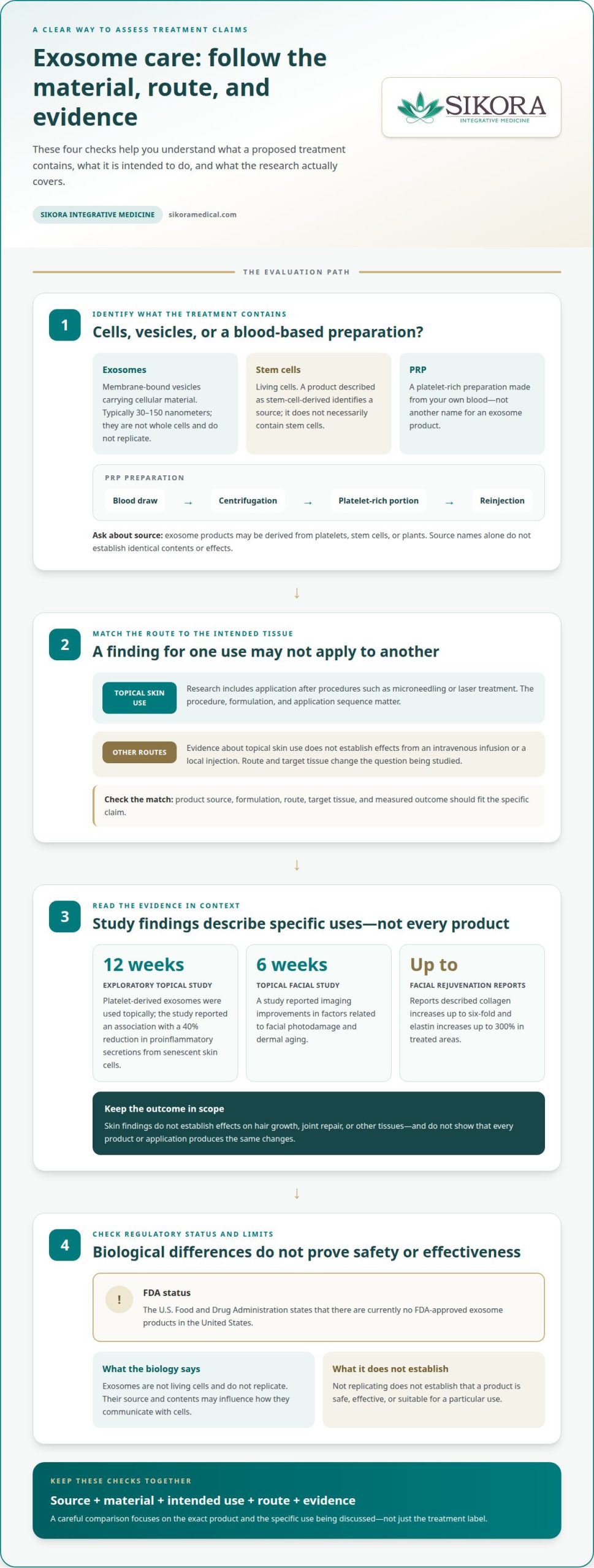
Exosome therapy uses exosomes, membrane-bound vesicles typically measuring 30 to 150 nanometers. They carry proteins and other cellular materials between cells. Rather than acting as whole cells, they serve as messengers that may influence how cells respond. This differs from introducing stem cells themselves into tissue. The proposed connection to healing and repair comes from how these vesicles communicate with cells, not from replacing damaged tissue with new cells.
Platelet-derived exosomes and stem-cell-derived exosomes differ by their source. The first come from platelets; the second originate from stem cells. Both are vesicles, not intact source cells, and their names alone don’t establish identical contents or effects. Preparation and intended use matter when considering clinical evidence. For example, an exploratory study used topical platelet-derived exosomes for 12 weeks and reported an association with a 40% reduction in proinflammatory secretions from senescent skin cells. That finding describes a specific topical use, not every product or method of administration.
PRP is different: it is prepared from your own blood. The process involves a blood draw, centrifugation to separate the platelet-rich portion, and reinjection. Exosome products may instead be derived from platelets, stem cells, or plant sources, so they don’t follow the same preparation steps. PRP therefore isn’t another name for an exosome treatment. Their materials and processes differ, even when both are discussed in regenerative care.
Stem-cell therapy involves stem cells, while exosomes aren’t living cells and don’t replicate. That distinction may inform how each approach is described, but it doesn’t establish which option is more effective or suitable. The U.S. Food and Drug Administration states that there are currently no FDA-approved exosome products in the United States. Product source, intended use, and clinical evidence are key considerations when evaluating claims.
Exosome Therapy Compared With PRP and Stem Cell Therapy
The clearest distinction is what the treatment contains: stem cells are cells, while exosomes are vesicles released by cells. Exosomes do not replicate or multiply into a growing cell population. They are studied for their role in carrying signals, including proteins and genetic material, between cells. This makes them biologically different from living cells. A product described as stem-cell-derived contains material from that source, but is not necessarily made of stem cells.
A stem cell is a whole cell; an exosome is a small, membrane-bound package of cellular material. This distinction matters when evaluating claims about growth or tissue response. Exosomes do not become stem cells after administration, and their contents do not make them living cells. Calling a product stem-cell-derived identifies its source; it does not establish that it acts like a stem-cell treatment.
PRP is a separate category. It is prepared from your own blood, while exosome products are distinct materials. A platelet-derived exosome is not equivalent to PRP just because both involve platelets. PRP is a platelet-rich preparation made for injection; an exosome product consists of vesicles. The distinction is between a blood-based preparation and vesicles associated with a cellular source.
For a proper comparison, consider the source, material, intended tissue, route, and evidence for the exact use. An aesthetic application and an injection intended for another tissue aren’t interchangeable examples; route and target affect what evidence applies. Since exosomes don’t replicate, their biology differs from living cells and limits concerns about immune reactions or oncogenesis. That difference doesn’t establish safety or effectiveness. Claims should match the specific product and its intended action.
Potential Exosome Therapy Applications
Research on exosome applications includes topical use after procedures such as microneedling and laser treatment. In these settings, material is applied to the skin after the procedure rather than injected as a stem-cell treatment. Exosomes are extracellular vesicles released by cells, and their cargo can include proteins involved in cell-to-cell signaling. This proposed role explains research interest, but does not establish a clinical result for every product.
With microneedling, a professional performs the skin procedure before applying topical exosomes. Research suggests this pairing may enhance treatment effectiveness and patient satisfaction. Exosomes may also support healing after laser treatment. The sequence and formulation matter: findings about one topical application don’t automatically apply to another product or route. Patients should distinguish evidence for a particular skin procedure from broader claims about regenerative effects.
Some reported findings focus on facial skin. A six-week study of topical exosomes reported imaging improvements in factors related to facial photodamage and dermal aging. Facial rejuvenation reports have described collagen increases up to six-fold and elastin increases up to 300% in treated areas. These findings concern skin outcomes; they don’t establish effects on hair growth, joint repair, or other tissues. Nor do they show that every application produces the same changes.
Regenerative medicine research examines how exosomes may affect cellular signaling in different tissues, but the application and route shape the question being studied. Evidence for topical use after microneedling does not establish effects from an intravenous infusion or local injection. The product’s source and formulation, target tissue, and measured outcome should match the claim. This helps you assess the evidence without treating all extracellular vesicles as interchangeable.
Potential Inflammatory and Disease-Promoting Effects
Exosomes carry proteins and genetic material involved in cell-to-cell communication. Their potential effects depend on their source, contents, and intended use. A product may contain growth factors or other cellular materials, but these contents do not guarantee controlled tissue repair. Skin research has examined measures such as collagen, elastin, and photodamage. Such findings concern specific applications, not broad proof of safety or effectiveness across treatments.
An exploratory study used topical platelet-derived exosomes for 12 weeks and associated treatment with a 40% reduction in proinflammatory secretions from senescent skin cells. This finding concerns one formulation and application. Early clinical studies generally involve small patient groups, short follow-up periods, and products with different cellular sources. Those differences make it difficult to apply one study’s inflammation findings to another product or route.
Regulatory status is a key safety factor. The U.S. Food and Drug Administration states that there are currently no FDA-approved exosome products. In December 2019, the agency issued a public safety notification after serious adverse events in patients treated with unapproved products marketed as containing exosomes. Unregulated therapies may involve potential risks and unsubstantiated claims.
After aesthetic treatment, redness or swelling usually subsides within a few days. That short-term response doesn’t answer questions about longer-term effects, product quality, or disease-related risks. Clinical trials are assessing administration risks and how long exosomes remain in the body; some use a small test dose before a larger dose. For you, the practical distinction is between a reported skin response and established treatment safety. Evidence and regulatory status should be explained before you decide.
U.S. disease/function-affecting exosome products are FDA-regulated drugs/biological products, generally requiring premarket review/approval. Restrict use to FDA biologics license applications or clinical studies; platelet-derived exosomes: topical only, no FDA-approved injection indications except in FDA clinical trials.
Exosome and Regenerative Medicine Services in Vero Beach
Sikora Integrative Medicine provides exosome, PRP, and stem cell services in Vero Beach. A physician-led discussion can clarify how these options differ, what each is intended to address, and what evidence applies to the proposed use. The goal is an informed decision, not an assumption that one approach suits every concern.
Dr. Alita Sikora has practiced in Vero Beach since 2007 and completed residency at NewYork-Presbyterian. A physician directs aesthetic treatments, supported by a credentialed clinical team. For skin-related concerns, this structure helps connect a proposed application with its evidence and safety considerations. The team explains evidence and regulatory status before you decide, so you can understand the treatment’s intended use and limitations.
PRP is prepared from your own blood on-site using the EmCyte PurePRP system. For joint and soft-tissue concerns, musculoskeletal ultrasound is used for evaluation and injection guidance when appropriate. The material and preparation differ from exosome and stem cell approaches, so the discussion should begin with your concern and the treatment being considered.
Exosome and stem cell services are also part of the clinic’s regenerative medicine care. These terms describe different materials, and their intended use and supporting evidence matter when comparing options. If you’re exploring treatment for a specific concern, the clinical team can explain what is known about the proposed approach, its regulatory status, and how it relates to your goals. Not every option is suitable for every patient, and no treatment outcome is promised.
Contact Sikora Integrative Medicine to discuss your treatment questions.
Frequently Asked Questions
How many exosome sessions do you need?
There is no single session count for every treatment goal. Before planning visits, define the outcome being assessed, the area being treated, and how progress will be reviewed. Clarify whether the schedule is planned as a course or reconsidered at follow-up. This gives you a practical basis for understanding a proposed plan instead of relying on a number from a different use.
Do exosome treatments really improve the skin?
To assess a skin treatment, start with a clearly stated concern rather than a broad promise of “rejuvenation.” Ask what visible change the treatment aims to address and how it will be assessed. This distinguishes an observable goal from general promotional language and gives you a clearer basis for discussing progress at follow-up.
How Do Exosomes Differ from Stem Cells?
Because these terms describe different materials, make sure the consent discussion names the specific treatment being proposed. Clarify its intended use and why it was selected for your concern. This helps you understand the procedure you are agreeing to and avoid assumptions based on a treatment label alone.
What are Exosomes and Why Are They Important?
The importance of exosomes in medicine lies in the questions they raise for research, not in proof that a treatment works. For a proposed use, focus on evidence tied to the specific product, route, and outcome being discussed. Separating a biological explanation from a clinical claim can help you assess whether the rationale fits the treatment goal.
What are the Risks?
Before deciding, ask what follow-up is planned and whom to contact if you notice an unexpected change after treatment. Clarify how the product and administration details will be documented. These practical points help you discuss concerns, but do not replace a review of your health history and the treatment’s safety information. This content is for educational purposes only and does not constitute medical advice.
What is the difference between exosome treatment and PRP?
PRP is made from your own blood, while exosome treatment involves a separate product. For a practical comparison, ask what material is used, how it is prepared, and what evidence supports its intended use. If a blood draw is a concern, raise it during the discussion. These labels describe different procedures, not interchangeable names for one treatment.

Article by
Alita G. Sikora, MD
Dr. Alita Gonsalves Sikora, MD, specializes in Physical Medicine and Rehabiltation (also known as Physiatry) and has practiced in Vero Beach since 2007. She started her own practice, Sikora Integrative Medicine, in 2017 in Vero Beach and also offers telemedicine to Florida residents.
Physical Medicine and Rehabilitation is a medical specialty focused on restoring function and treating pain in the bones, muscles, joints, and nervous system, most often without surgery. She trained at the University of Connecticut School of Medicine and did her residency training at NY Presbyterian (Columbia and Cornell) in NYC.
She offers regenerative and integrative approaches, treating chronic pain and musculoskeletal conditions with stem cells, PRP, exosomes, peptides, shockwave therapy, laser therapy, acupuncture, and prolotherapy, as well as traditional medications and injections. She also certifies qualified patients for medical marijuana in the state of Florida.
She also offers bioidenical hormone optimization including pellets, medical weight loss, peptides, IV vitamin therapy, and functional lab testing.

 1255 37th St. Suite B,