
 772-228-6882




To qualify for a Kentucky medical marijuana card, you must be a Kentucky resident with a current diagnosis of a qualifying condition and complete an evaluation with a medical marijuana doctor.
Kentucky lists conditions such as cancer, chronic or debilitating pain, epilepsy, multiple sclerosis, and post-traumatic stress disorder, along with additional symptom-based eligibility pathways.
This guide explains what records and appointments to prepare for, how certification leads to a card application, and when your card expires.
Key Takeaways
- Review the diagnoses and symptom-based pathways that may make a condition eligible under Kentucky’s program.
- Learn which medical records can help document your diagnosis and what to prepare for an evaluation.
- Understand the steps between practitioner certification and applying for your state card.
- Find out how long certification lasts and what renewal timing to keep in mind.
How to Qualify for a Kentucky Medical Marijuana Card
Medical cannabis eligibility depends on the rules of your state, your diagnosis, and an evaluation by a qualified practitioner. Product and possession rules also vary by state.
Condition Eligibility
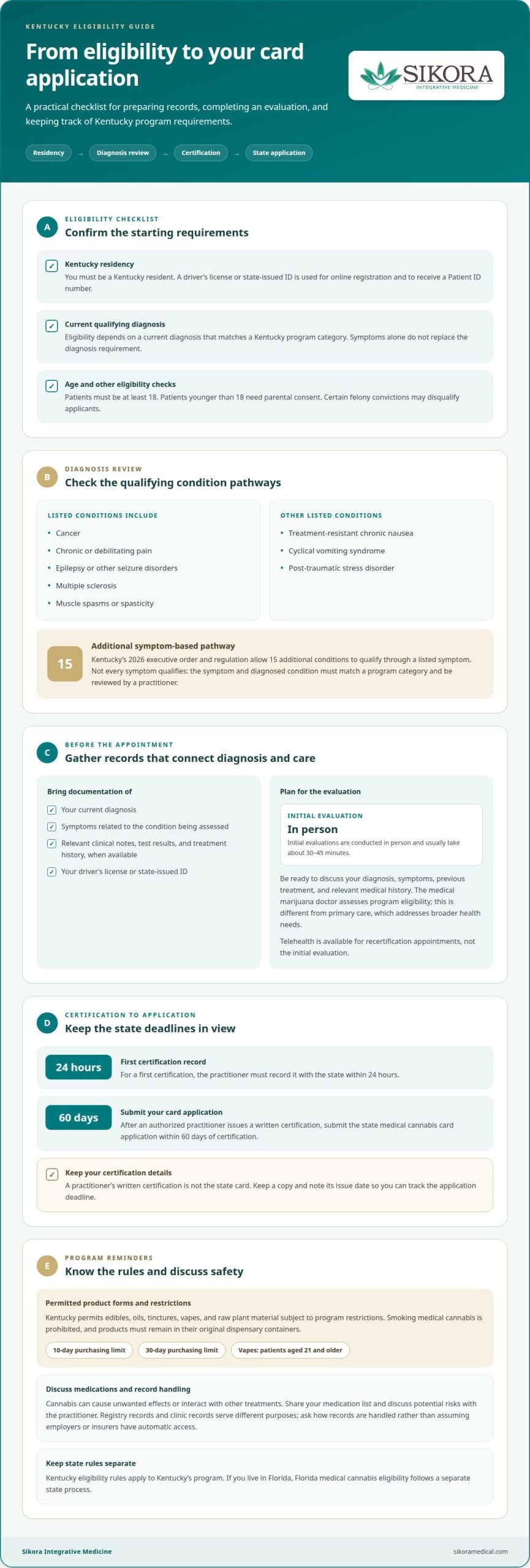
Kentucky requires residency and a current diagnosis that meets its qualifying criteria. Listed conditions include cancer, chronic or debilitating pain, epilepsy or other seizure disorders, multiple sclerosis, muscle spasms or spasticity, treatment-resistant chronic nausea or cyclical vomiting syndrome, and post-traumatic stress disorder.
Kentucky’s 2026 executive order and regulation also allow 15 additional conditions to qualify through a listed symptom. Bring records that document your diagnosis and symptoms, so the practitioner can assess whether your condition fits the program. Certain felony convictions may disqualify applicants.
In-Person Evaluation and Doctor Roles
A medical marijuana doctor evaluates whether your diagnosis meets the state program’s criteria. This is different from primary care, which addresses your broader health needs. Your primary care records may be relevant, but the certification evaluation focuses on program eligibility. Evaluation arrangements may vary, so confirm what to expect when scheduling.
Authorized practitioners may issue written certifications recommending medical cannabis. The evaluation is expected to take about 30-45 minutes. Bring documentation of your current diagnosis and relevant treatment history to support the discussion.
Kentucky permits edibles, oils, tinctures, vapes, and raw plant material, subject to program restrictions. Smoking medical cannabis is prohibited, and products must stay in their original dispensary containers. Patients must follow 10-day and 30-day purchasing limits; vape products are limited to patients aged 21 and older.
Medical cannabis is legal for eligible patients under Kentucky’s state program, including in Louisville. As of October 29, 2026, Louisville had one operating dispensary, while a second Jefferson County licensee had not opened. Recreational marijuana remains illegal in Kentucky.
Do not assume employers or insurers have automatic access to your clinical records. Registry records and clinic records serve different purposes, so ask about record handling during your evaluation. Cannabis can cause unwanted effects or interact with other treatments. Share your medication list and discuss potential risks with the practitioner before deciding.
Qualifying medical conditions
Kentucky medical cannabis eligibility is based on a current diagnosis, not symptoms alone. Listed categories include cancer, chronic or debilitating pain, epilepsy or other seizure disorders, multiple sclerosis, muscle spasms or spasticity, treatment-resistant chronic nausea, cyclical vomiting syndrome, and post-traumatic stress disorder. Compare your diagnosis with the state’s criteria.
A separate pathway matters for some patients. Kentucky’s 2026 executive order and regulation allow 15 additional conditions to qualify through a listed symptom. That means the symptom pathway may apply even when a condition isn’t among the named diagnoses above. Residents should identify the specific symptom and how it relates to their diagnosed condition before discussing eligibility.
A physician’s role is to assess whether your current diagnosis meets a qualifying category and, if eligible, issue a written certification. A diagnosis by itself doesn’t replace that certification step. The medical marijuana doctor evaluates your records and clinical history against program criteria, then documents the recommendation. A certification is the practitioner’s written support for applying to the Kentucky medical marijuana program, not the state card itself.
Organize records around the condition you want assessed. For example, someone with epilepsy can bring documentation of that diagnosis, while a patient with chronic pain can gather records describing the diagnosed pain condition. Include relevant clinical notes and treatment history when available. Clear records help connect the diagnosis, symptoms, and reason for seeking medical cannabis. The appointment can then focus on whether those details support a qualifying condition.
Kentucky’s symptom-based route doesn’t mean every symptom qualifies. Eligibility depends on the condition and symptom matching a program category, followed by practitioner review. If you live in Florida, Florida medical cannabis eligibility follows a separate state process, so Kentucky criteria won’t determine your Florida status.
Medical records and appointment requirements
Before your Kentucky appointment, organize records that show your current diagnosis and relevant care. Clinical notes, test results, and treatment history can help connect your symptoms with the condition being assessed. Bring identification too, because Kentucky residents use a driver’s license or state-issued ID to register online and receive a Patient ID number.
Initial medical cannabis evaluations in Kentucky are conducted in person and usually take about 30-45 minutes. Set aside time to describe your diagnosis, symptoms, and previous treatment. Patients can complete recertification appointments through telehealth. Keep the distinction clear: telehealth is an option for recertification, while the initial evaluation is in person.
Age and residency are separate eligibility checks. Kentucky residents must be at least 18 years old to qualify as patients under the eligibility requirements listed by Kentucky Marijuana Card. Patients younger than 18 need parental consent under those requirements. A parent should be prepared to participate in the process and provide consent for the minor’s evaluation.
After an authorized practitioner issues a written certification, the state application has its own deadlines. Kentucky patients must submit their medical cannabis card application within 60 days of certification. For a first certification, the practitioner must record it with the state within 24 hours. These steps connect your evaluation, certification, and application, so keep a copy of the certification and note its issue date.
Renewal requires a fresh certification, not simply the previous appointment record. Kentucky patients can complete recertification by telehealth, then submit the renewal application within the required timeframe. Executive Order 2025-335 waives the renewal fee for patients whose card was approved in 2025, if their renewal is approved in 2026. Keep your approval notice and current medical records together to support the renewal process and avoid scrambling as the expiration date approaches.
Will my medical cannabis card expire?
Yes. A Kentucky medical marijuana certification is valid for 1 year, so you’ll need recertification to keep your registry card current. A medical marijuana doctor evaluates your condition and may issue written certification if you meet the program criteria. That certification supports your application; it isn’t the marijuana card itself.
Your first step is an appointment with an authorized medical cannabis practitioner before applying for a registry identification card. After receiving written certification, submit your application to the Kentucky Office of Medical Cannabis within 60 days. The office decides complete applications within 30 days. The card is mailed 7-10 days after the required state payment is made.
For renewal, plan the practitioner visit around your card’s expiration date. According to the Kentucky Legislative Research Commission, a registry-card renewal requires certification from a medicinal cannabis practitioner issued within the preceding sixty (60) calendar days. A certification older than that window won’t meet this renewal requirement. Keep the certification date and card expiration date together in your calendar.
How do you find a licensed practitioner near you? Use Kentucky’s practitioner directory and enter a city or ZIP code, or select a county. The directory includes 25-mile and 50-mile search distance options. For example, a Louisville resident can search by city and choose a distance that suits their travel plans.
A caregiver may assist a patient with program needs, but the patient’s certification and renewal remain tied to the patient’s eligibility. Keep application notices, certification records, and the digital card information together. If you’re ready to discuss a Florida evaluation, schedule a medical marijuana evaluation and ask about the steps for your situation.
Sikora Integrative Medicine: Stem Cells
Sikora Integrative Medicine is based in Vero Beach and serves Florida residents. Its medical cannabis evaluations follow Florida’s process, which is separate from Kentucky card eligibility and any decision about regenerative care.
For joint or soft-tissue concerns, the practice offers Stem Cells, PRP, and Exosomes. Hormone Therapy is also available for people seeking care for hormone-related concerns. An individualized discussion can help clarify whether these services align with your health goals.
For details about these care options, visit Sikora Integrative Medicine online.
Choose the Next Step That Fits Your Health Goals
Kentucky card eligibility and Florida care are separate matters. If you live in Vero Beach or elsewhere in Florida and are considering medical cannabis, Sikora Integrative Medicine provides Florida certification and registry guidance. The practice also offers Stem Cells, PRP, and Hormone Therapy for other health goals.
A medical marijuana doctor evaluates eligibility under the applicable state program. For broader health concerns, discuss your priorities and relevant medical history with a qualified healthcare provider to understand which care options may be appropriate.
For a Florida evaluation or to discuss care in Vero Beach, contact Sikora Integrative Medicine. Take the next step when you’re ready.
Frequently Asked Questions
Is approval guaranteed after an evaluation?
No. An evaluation doesn’t guarantee a written recommendation or state approval. The practitioner assesses the patient’s clinical information, and the Kentucky Office of Medical Cannabis handles the application decision. If Kentucky denies an application, the patient may request a hearing within 30 days. Keep the denial notice and related paperwork together so you can refer to the decision and its date.
Have questions about medical cannabis in Louisville?
Visiting patients in Louisville have separate rules from Kentucky residents applying for their own cards. An out-of-state medical marijuana card may be used at a Louisville dispensary by visiting patients who are at least 21 years old. This visitor access doesn’t convert an out-of-state card into a Kentucky patient registration. Caregiver registration is another distinct role in the program.
Can out-of-state residents apply?
Out-of-state residents can’t apply for a Kentucky patient card as Kentucky residents. If you’re helping someone as a caregiver, note that Kentucky caregivers must be at least 21 years old and may assist up to three patients. Caregiver participation is separate from applying as a patient, so don’t treat a caregiver role as a substitute for patient eligibility.
Do I have to be in person for my appointment?
Kentucky’s first evaluation is conducted in person. Prepare a brief timeline of symptoms and treatment changes, along with your medication list and questions about medical cannabis. Mention concerns such as possible interactions or effects on daily activities so the practitioner can consider your health history and goals.
Do you offer telehealth evaluations in Louisville?
Sikora Integrative Medicine serves Florida residents and does not provide Kentucky medical cannabis evaluations. Its TeleMed Services cover eligible hormone optimization, peptide therapy, and medical weight loss, not medical cannabis evaluations. Florida residents can discuss Florida certification and registry guidance with the practice. TeleMed visits require you to be physically located in Florida.
What conditions qualify for medical marijuana in my state?
Eligibility depends on the program in your state, so Kentucky rules do not determine eligibility in Florida. Florida residents can discuss their diagnosis and health history during an evaluation for Florida certification and registry guidance. Bring relevant records and questions about how the state process applies to your situation. This information is educational only, not medical advice; consult a qualified healthcare provider.

Article by
Alita G. Sikora, MD
Dr. Alita Gonsalves Sikora, MD, specializes in Physical Medicine and Rehabiltation (also known as Physiatry) and has practiced in Vero Beach since 2007. She started her own practice, Sikora Integrative Medicine, in 2017 in Vero Beach and also offers telemedicine to Florida residents.
Physical Medicine and Rehabilitation is a medical specialty focused on restoring function and treating pain in the bones, muscles, joints, and nervous system, most often without surgery. She trained at the University of Connecticut School of Medicine and did her residency training at NY Presbyterian (Columbia and Cornell) in NYC.
She offers regenerative and integrative approaches, treating chronic pain and musculoskeletal conditions with stem cells, PRP, exosomes, peptides, shockwave therapy, laser therapy, acupuncture, and prolotherapy, as well as traditional medications and injections. She also certifies qualified patients for medical marijuana in the state of Florida.
She also offers bioidenical hormone optimization including pellets, medical weight loss, peptides, IV vitamin therapy, and functional lab testing.

 1255 37th St. Suite B,