
 772-228-6882



What if the solution to your chronic hip pain isn’t a titanium replacement, but a biological “software update” that leverages your body’s own restorative power? If you find yourself dreading the stairs or waking up every time you roll over in bed, you’re all too familiar with the limitations of traditional care. You’ve likely experienced the frustration of steroid injections that wear off in weeks and the looming fear of losing your independence during a grueling three-month surgery recovery. It feels like you’re simply managing a decline rather than reclaiming your life.
There is a more sophisticated way to address the underlying degeneration without the trauma of a joint replacement. You’re about to discover how advanced stem cell therapy for hip pain can repair damaged tissue and dampen systemic inflammation to restore your natural range of motion. By prioritizing your body’s innate cellular capabilities, it’s possible to return to the golf course or enjoy long walks without the burden of daily medication. This article provides a clear, evidence-based look at the 2026 landscape of regenerative medicine and helps you decide if a non-surgical path is the right choice for your mobility.
Key Takeaways
- Identify the anatomical reasons why hip joints are prone to wear and why traditional treatments like steroid injections often provide only temporary relief.
- Understand the biological mechanism of stem cell therapy for hip pain and how it utilizes signaling cells to shift your joint environment toward active restoration.
- Contrast the days-long recovery of non-surgical biological treatments with the months of intensive rehabilitation required after a total hip replacement.
- Learn the clinical evaluation steps and imaging requirements used to determine if your specific hip condition is ideal for regenerative intervention.
- Explore how a personalized, integrative approach combining cellular therapy with shockwave and nutritional support can optimize your long-term functional outcomes.
Understanding Chronic Hip Pain and the Limits of Traditional Care
If you have been told that your hip is “bone-on-bone,” it’s easy to feel like surgery is your only remaining option. The hip is a complex ball-and-socket joint designed for a massive range of motion and weight-bearing stability, but this constant demand makes it highly susceptible to wear and tear. While the diagnosis of osteoarthritis is common, other culprits like labral tears, bursitis, or even osteonecrosis (the loss of blood supply to the bone) can create a landscape of debilitating pain. Traditional medicine often views the hip as a simple mechanical hinge, but this perspective frequently overlooks the complex cellular dialogue required for joint health.
The term “bone-on-bone” is often a misunderstood diagnosis that focuses solely on what is visible on an X-ray while ignoring the vitality of the surrounding soft tissue. If the biological environment of the joint is dominated by chronic inflammation, even a joint with some remaining cartilage will feel excruciating. Many patients fall into the “Steroid Cycle,” relying on repeated cortisone shots for temporary relief. However, research suggests that frequent steroid injections can actually weaken hip tendons and accelerate cartilage breakdown over time. This is why understanding The Science of Regeneration: How Stem Cells Repair Hip Tissue is so vital; it offers a shift from masking symptoms to restoring the joint’s internal balance.
The Problem with the “Wait and See” Approach
Chronic inflammation is not a static state; it is a progressive process that actively destroys cartilage. If you choose to “wait and see” while your mobility declines, you aren’t just living with pain, you’re allowing the joint environment to become increasingly toxic to your remaining healthy cells. The psychological toll of this decline is significant, as the loss of independence and the inability to participate in hobbies like golf or walking can lead to a profound sense of frustration. Early intervention with stem cell therapy for hip pain aims to interrupt this degenerative cycle before the damage becomes irreversible.
Limitations of Traditional Hip Surgery
Total hip arthroplasty (THA) is a major surgical procedure that carries inherent risks, including infection, blood clots, and a grueling recovery period that can last months. For younger or highly active patients, the “Revision Problem” is a major concern, as prosthetic joints have a limited lifespan and second surgeries are far more complex and less successful. Traditional care often fails because it focuses on a mechanical replacement of parts rather than addressing the underlying biological environment that caused the joint to fail in the first place. Choosing stem cell therapy for hip pain allows you to explore a path that prioritizes your body’s innate healing potential over invasive bone-cutting procedures.
The Science of Regeneration: How Stem Cells Repair Hip Tissue
Stem cell therapy for hip pain represents a fundamental shift from mechanical repairs to biological restoration. At its core, this therapy uses undifferentiated cells, specifically Mesenchymal Stem Cells (MSCs), to activate your body’s internal repair systems. These cells aren’t just building blocks; they’re sophisticated intelligence agents. When introduced into a degenerative hip joint, they “home in” on areas of damage by following a trail of chemical signals released by injured tissue. This process allows the cells to concentrate exactly where the structural integrity of the joint is most compromised.
Once they arrive, MSCs act as an anti-inflammatory powerhouse. In an arthritic hip, the joint fluid often becomes a “toxic” soup of inflammatory proteins that accelerate cartilage breakdown. Stem cells help neutralize this environment, shifting the joint from a state of constant destruction to one of active protection. This biological intervention is a primary reason why researchers analyze the success of Stem Cell Therapy vs. Total Hip Replacement: A Comparative Look, especially regarding the preservation of the femoral head in complex cases. If you’re ready to move beyond temporary fixes, a customized pain management strategy can help you harness these regenerative signals.
Stem Cells vs. Exosomes: The Next Generation of Healing
While stem cells are the “factories,” exosomes are the “delivery trucks.” Exosomes are tiny extracellular vesicles that carry vital genetic information and proteins between cells. By combining stem cell therapy for hip pain with exosomes, clinicians can provide a faster, more concentrated signaling burst. This combination targets chronic hip inflammation more effectively than cells alone because it provides both the long-term cellular presence of stem cells and the immediate, targeted communication of exosomes to calm a hyperactive immune response.
The Paracrine Effect: It’s About the Signal, Not Just the Cell
Modern regenerative medicine has moved past the simplistic idea that stem cells simply turn into new cartilage. Instead, we now understand the “paracrine effect,” where stem cells act as conductors for your body’s natural healing orchestra. They release a variety of growth factors and cytokines that command your resident cells to resume repair work. MSCs primarily function by secreting bioactive molecules that inhibit pain and stimulate local tissue repair. This means that while some cartilage regrowth may occur, the most immediate benefit is often the profound reduction in pain and the stabilization of the joint’s biological health.
Stem Cell Therapy vs. Total Hip Replacement: A Comparative Look
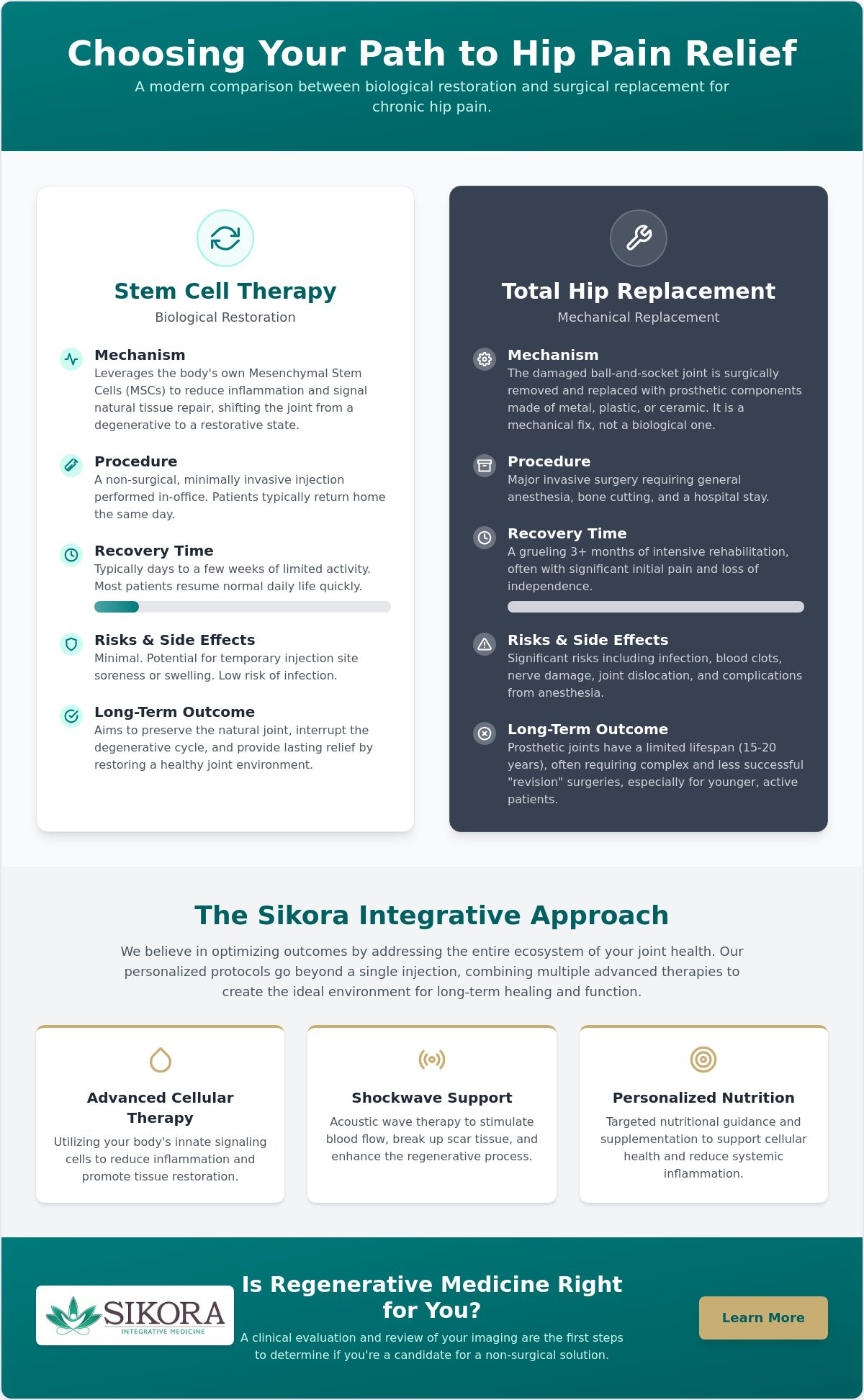
Choosing between regenerative medicine and major surgery is a pivotal decision that defines your quality of life for years to come. While a total hip replacement involves the surgical removal of bone and the insertion of a metal or ceramic prosthetic, stem cell therapy for hip pain focuses on preserving your biological hardware. The difference in invasiveness is stark. A regenerative procedure is typically performed via a precise, image-guided injection, whereas surgery is a high-trauma event requiring general anesthesia and significant tissue disruption. If you prefer a path that respects your body’s natural architecture, the shift toward cellular restoration is a compelling alternative.
The timeline for recovery highlights the most immediate benefit of non-surgical care. Most patients undergoing regenerative treatments return to light activity within days, experiencing only minor soreness at the injection site. In contrast, surgical recovery is measured in months, often requiring intensive physical therapy and a slow return to basic independence. When reviewing the current evidence on stem cells for hip osteoarthritis, the safety profile remains a standout feature. Because these therapies use your own biological material, the risk of rejection or systemic reaction is minimal, especially when compared to the potential for surgical complications like blood clots, infection, or prosthetic loosening.
When Surgery is Truly Necessary
There are instances where structural damage has progressed beyond the reach of biological signaling. If a patient presents with “Stage 4” collapse or severe mechanical deformity, the structural integrity of the joint may be too compromised for cellular repair alone. Dr. Sikora acts as a dedicated advocate for the right treatment at the right time, ensuring patients don’t pursue regenerative paths when surgery is the clinically responsible choice. Even in these cases, regenerative medicine can play a supportive role by enhancing post-surgical healing and managing inflammation in the surrounding soft tissues.
The Economic Value of Regenerative Medicine
Evaluating the cost of care requires looking beyond the initial procedure price to consider the “biological ROI” of your natural joint. Surgery carries significant hidden costs, including weeks of lost wages, the expense of home care, and the ongoing maintenance of a prosthetic that may eventually require a complex revision. Investing in your hip’s innate health can prevent these downstream burdens. To gain a better perspective on the financial landscape of regenerative options, many patients start by researching the PRP injection cost and long-term value. This provides a baseline for understanding how biological treatments prioritize long-term functional relief without the high physical and financial price of a hospital stay.
Determining Candidacy: Is Stem Cell Therapy Right for Your Hip Pain?
Not every hip is a candidate for regeneration. The success of stem cell therapy for hip pain depends heavily on precise patient selection and a thorough understanding of your joint’s current biological state. We begin with a clinical evaluation that goes beyond a simple review of X-rays or MRIs. We look at the degree of mechanical dysfunction versus inflammatory pain. If your pain is primarily driven by systemic inflammation, the approach differs from a hip struggling with a structural labral tear; identifying these nuances is essential for a high-quality outcome.
Your lifestyle goals also dictate the treatment path. Are you looking to return to competitive tennis, or is your primary objective to walk through the grocery store without a cane? We align the cellular protocol with your functional expectations. Perhaps the most critical step is the metabolic health screening. We often describe the body as the “soil” and the stem cells as the “seeds.” If your internal environment is depleted of essential nutrients or hormonal balance, those seeds cannot thrive. This holistic view is why we often incorporate longevity strategies to ensure your body is primed for a successful regenerative response.
Ideal Candidates for Hip Stem Cell Therapy
Patients with mild to moderate osteoarthritis, specifically those classified as Kellgren-Lawrence Grade 2 or 3, typically see the most significant benefits. If you have a labral tear and want to avoid the risks of arthroscopy, or if you are in the early stages of avascular necrosis, you may be an ideal candidate. These conditions represent a window of opportunity where the joint still possesses enough structural integrity to respond to biological signaling. This “sweet spot” of intervention allows the cells to effectively modulate the immune response before the joint reaches a state of total mechanical failure.
Who Should Consider Other Options?
Honesty is the foundation of our practice. If you are experiencing severe joint deformity or complete femoral head collapse, the mechanical failure may have progressed too far for cellular therapy to be the primary solution. Additionally, active systemic infections or certain blood-borne cancers are contraindications for this treatment. As a Board Certified Physical Medicine and Rehabilitation specialist, Dr. Sikora provides a transparent assessment to ensure you are directed toward the most effective care. If you are ready to see where you stand on the path to recovery, you can schedule a candidacy evaluation to discuss your specific options.
The Sikora Approach: Personalized Regenerative Medicine in Vero Beach
Dr. Alita Sikora brings a unique perspective to regenerative medicine as a Board Certified Physical Medicine and Rehabilitation specialist. This specific medical background is a game-changer for patients because it focuses on functional restoration rather than just symptom suppression. While many clinics offer injections, Dr. Sikora evaluates how your hip pain affects your entire kinetic chain, from your lower back to your gait. If you’ve been searching for stem cell therapy for hip pain, you don’t need to travel to a major metropolitan hub to find world-class technology. Our Vero Beach practice provides a sophisticated, local sanctuary where the latest biological advancements are delivered with a compassionate, patient-centered touch.
We believe that true healing requires more than a single procedure. The “Sikora Approach” is defined by an integrative philosophy that treats the joint as part of a living, breathing system. During your first consultation, we don’t just look at your MRI; we listen to your story and assess your goals. We want to know if you’re aiming to return to the pickleball court or simply want to sleep through the night without a dull ache. This personalized deep dive allows us to craft a roadmap that aligns our clinical expertise with your specific vision for a mobile, active future.
Comprehensive Healing Beyond the Injection
Success in regenerative medicine is often determined by the “soil” in which the “seeds” are planted. We use Longevity Peptides to prime your systemic biology, ensuring your body has the necessary signaling power to support cellular repair. Additionally, Shockwave Therapy plays a vital role in our protocols by using acoustic pressure waves to break up restrictive scar tissue and stimulate localized blood flow to the hip joint. This multi-layered strategy, which often includes personalized health coaching and nutritional support, ensures that we’re addressing the root causes of degeneration rather than just the surface-level pain.
Your Journey to Mobility Starts Here
We’ve streamlined the path to recovery to respect your time and comfort. Your journey typically begins with a convenient TeleMed consultation to discuss your history and candidacy, followed by a precise, image-guided procedure in our welcoming office. Our patient family includes many Vero Beach neighbors who once felt trapped by their limitations but have since reclaimed their independence. These real-world success stories prove that avoiding the knife is a tangible reality when you choose a path that respects your body’s innate capabilities. If you’re ready to stop managing your decline and start your restoration, we’re here to guide you. Schedule your hip pain evaluation with Dr. Sikora today.
Your Path to Restored Vitality and Movement
Choosing to move beyond the cycle of temporary injections and invasive surgeries is a profound step toward long-term joint health. You’ve learned how stem cell therapy for hip pain leverages your body’s own signaling power to shift a degenerative environment toward active restoration. By integrating these biological “software updates” with personalized nutrition and supportive therapies, it’s possible to stabilize your hip and avoid the trauma of a total joint replacement.
As Vero Beach’s leading pioneer in integrative regenerative medicine, Dr. Alita Sikora uses her background as a Board Certified Physical Medicine and Rehabilitation specialist to design your recovery. Her customized protocols combine stem cells, exosomes, and PRP to address the unique biological landscape of your joint. If you’re ready to trade chronic discomfort for renewed mobility, the first step is a clinical evaluation that prioritizes your body’s innate potential.
Book Your Consultation with Dr. Alita Sikora in Vero Beach and discover a life without physical limitations. Your journey toward a more active, pain-free future starts with a single conversation.
Frequently Asked Questions
Is stem cell therapy for hip pain FDA-approved?
As of 2026, the FDA has not approved any stem cell products for the general treatment of orthopedic conditions like hip pain. The agency regulates these cellular treatments as biologics, which require extensive clinical testing to achieve formal approval. While many clinics offer these procedures under specific regulatory guidelines for minimal manipulation, they are currently considered investigational rather than the standard of medical care.
How long does it take to see results after a stem cell injection in the hip?
Most patients begin to notice functional improvements within four to eight weeks following the procedure. Unlike steroid injections that provide immediate but temporary numbing, stem cell therapy for hip pain works by gradually modulating inflammation and signaling tissue repair. Peak benefits are typically realized between three and six months as the joint environment stabilizes and the biological restoration takes full effect.
Does insurance cover stem cell therapy for hip osteoarthritis?
Health insurance plans generally do not cover regenerative cellular therapies for hip osteoarthritis. Because these procedures are still classified as investigational or experimental by most major providers, they are typically an out-of-pocket investment for the patient. Many individuals utilize health savings accounts (HSA) or flexible spending accounts (FSA) to manage the costs associated with these advanced biological treatments.
How many treatments will I need for my hip pain?
Many patients achieve significant, long-lasting relief with a single, comprehensive treatment session. The total number of applications depends on the severity of your joint degeneration and your overall metabolic health. If the damage is more extensive, a multi-layered approach that includes follow-up PRP sessions or shockwave therapy may be recommended to ensure the internal environment remains conducive to long-term healing.
Is the procedure painful? What is the recovery like?
The procedure involves a precise, image-guided injection that most patients describe as a feeling of deep pressure rather than sharp pain. You might experience some localized soreness or a feeling of fullness at the injection site for 48 to 72 hours. Recovery is remarkably fast; most individuals return to light daily activities within a few days, avoiding the months of intensive rehabilitation required after major surgery.
Can stem cells help if I have been told I am “bone-on-bone”?
Stem cell therapy for hip pain can often provide relief for “bone-on-bone” diagnoses, provided there isn’t a complete structural collapse of the femoral head. While results are typically most robust in mild-to-moderate cases (Kellgren-Lawrence grades 2-3), the therapy’s ability to reduce toxic inflammation can significantly improve quality of life even in advanced stages. A thorough evaluation of your imaging is necessary to determine your specific candidacy.
What is the difference between bone marrow and adipose-derived stem cells?
Bone marrow-derived cells are harvested from the pelvic bone and are rich in Mesenchymal Stem Cells (MSCs) specifically suited for orthopedic repair. Adipose-derived cells are extracted from your own fat tissue and often provide a higher volume of cells with potent anti-inflammatory properties. Both sources have unique advantages, and the choice between them depends on your specific clinical profile and the nature of your hip pathology.
Can I drive myself home after the hip stem cell procedure?
We generally recommend that you have a friend or family member drive you home following your appointment. While the procedure is minimally invasive and doesn’t require general anesthesia, the local numbing agents and the nature of the hip injection can cause temporary stiffness or reduced sensitivity in the leg. Having a driver ensures your safety and comfort as you begin the initial 24-hour rest period.

 (772) 228-6883
 1255 37th St. Suite B,